



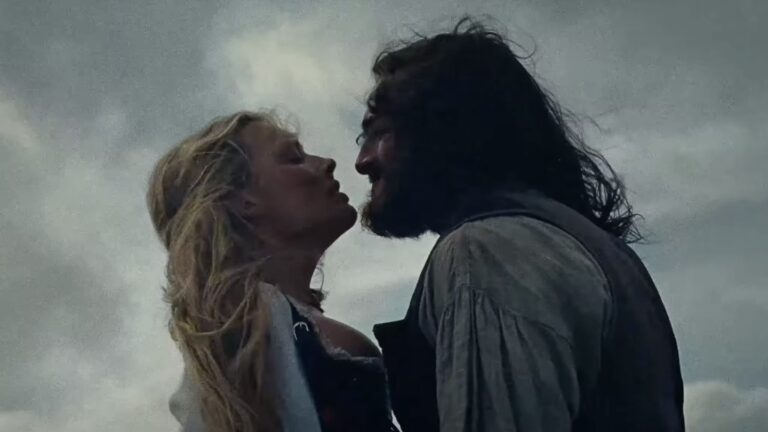
“Wuthering Heights” (2026 | UK | 135 minutes | Emerald Fennell)
Wuthering Heights is both the title of Emily Brontë’s only novel, published in 1847, and a new film by Emerald Fennell, out this week, which I will refer to as “Wuthering Heights.” One bears some resemblance to the other, but not too much, hence the quotation marks. It is like when there was once a Seattle rock band called “The Rolling Stones.”
I do not believe film adaptations owe strict faithfulness to their source material, particularly when the work has long been in the public domain, so I find it unfair to criticize the former for failing to follow the latter too closely. Literary fidelity be damned. There is a lot I admired in this movie.
The opening scene announces its intentions immediately. In the first moments, you hear the moans of a man who appears to be mid-coitus. That is not the case. He is in the middle of his own hanging. I appreciate the boldness from director Fennell, even when I wonder why she does not always sustain that momentum.
Early in the film, Fennell introduces Catherine Earnshaw and Heathcliff as children. She invites him into her home when he is a mute orphan. Her father (Martin Clunes) is initially welcoming, but his alcoholism soon takes over and he becomes cruel and abusive. As his drinking worsens, his prospects dim and the home, Wuthering Heights, falls further into disrepair.
Catherine and Heathcliff form a bond that appears unbreakable, though as they grow older, cracks begin to show in the façade. Heathcliff (Jacob Elordi) remains steadfast and loyal, but Catherine, played by Margot Robbie, sees a way out of poverty by marrying the neighborhood’s new eligible bachelor, Edgar Linton (Shazad Latif.) Mr. Linton is smitten with Catherine, understandable since she looks like Margot Robbie, and she chooses the better life his money and social standing offer. Heathcliff cannot bear the betrayal. After overhearing a conversation between Catherine and Nelly *Hong Chau), the housekeeper first to the Earnshaws and later to the Lintons, he leaves Wuthering Heights one night.
When he returns three years later, he is more gentlemanly and refined, and wealthy enough to purchase Wuthering Heights and become its landlord. He and Catherine begin a torrential affair that she attempts to end, but she cannot quit Heathcliff, and they are fornicating every chance they get. She is still bound to Edgar. Meanwhile, Edgar’s sister Isabella Alison Oliver) becomes enraptured by the handsome and brooding Heathcliff. They marry, and she willingly becomes part of Heathcliff’s sadistic revenge against Edgar and Catherine Linton.
I mostly appreciate Fennell’s take on this classic, often misunderstood novel. It is probably my second favorite novel of revenge, after The Count of Monte Cristo. Yet countless readers approach it expecting an epic love story, only to discover a tale of abuse, toxic relationships, and obsession. I thought I had experienced enough idiocy for a lifetime after reading every post in r/LinkedInLunatics over the past six months, and then I scrolled through one-star reviews on Goodreads. Lordy.
Fennell’s first film, Promising Young Woman, was one I initially found frustrating and reviewed with mixed feelings. As time passed, I grew even less charmed by it, and I sometimes get angry just thinking about it. I decided a while ago that Saltburn was decidedly not for me. “Wuthering Heights” is certainly her best feature to date.
Margot Robbie and Jacob Elordi are two fine actors ( and fine-looking ones) who seem well cast here, though at times I questioned their chemistry. The film meanders in places, but overall it is a bold and enjoyable take on one of literature’s great works.
Dropping this on Valentine’s weekend is darkly hilarious. It is an epic romance only for cult members who think psychological warfare counts as foreplay.
“Wuthering Heights” will be released in theaters everywhere on Friday, February 13.