



Eddington (2025 | USA | 149 minutes | Ari Aster)
Hard to believe it’s already been five years since the SARS-CoV-2 landed on our shores, and the response to the novel coronavirus shredded the hearts and minds of the United States into a toxic waste dump whose halflife remains unknown. Or at least that’s the feeling that one gets from watching Eddington, the latest from the twisted mind of horror auteur Ari Aster. After a Cannes premiere approximately coinciding with the anniversary of the COVID-19 pandemic, it crashes into theaters this weekend like the Kool-Aid Man running through a brick wall, but more painfully.
My main takeaway is that Aster had a very bad time during the pandemic (which he spent in New Mexico, where the film is set). I’m happy that he got to exorcise his demons, or sorry that happened to him, but the two and a half hours spent watching what the experience did to him felt worse than an entire year of lockdown. I wish I’d trusted my “I ain’t reading that” instincts and made a hasty run for the door the first time I checked my watch (forty minutes in, which felt like days).
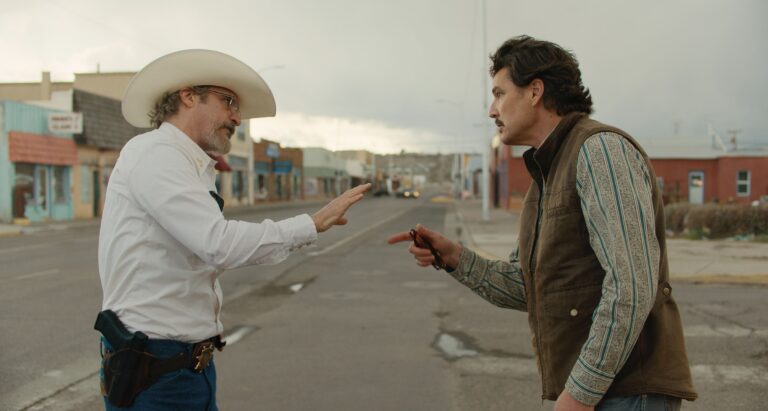
Set in a small New Mexico town of the same name, population in the thousands, Eddington immediately immerses itself in the tensions of jurisdictions and mask mandates. Joe Cross, the town sheriff (Joaquin Phoenix, stalwartly bumbling), might wear a white hat in this Western, but he refuses to cover his face. Despite a statewide order from the governor, endorsement from Ted Garcia, the town’s ambitious technocrat mayor (Pedro Pascal), encouragement from the adjoining Pueblo law enforcement, and seemingly widespread embrace from most of the town’s residents, the sheriff refuses to wear the mask with appeals to his health (“asthma”), logic (“it’s not here yet”), and eventually a “compassionate conservative” style appeal to individual liberties that will launch him into an impromptu political career.
All the hits of the summer of 2020 make it into the small-town powder keg. A man experiencing homelessness mutters and menaces his way through the town, sparking confrontations. The city council contravenes mandatory closures by holding business meetings in the mayor’s bar. Residents shame anti-maskers out of the grocery store. Kids sneak out to congregate outdoors in masked and “double-distanced” gatherings to avoid losing their minds (and to hit on girls with freshly Googled takes). Some of the compliance is related to staying aligned with a governor who’s going to bring an AI datacenter and attendant jobs to the edge of town. The modern aluminum building stands out in opposition to the small town and is plastered with a “solidgoldmagikarp” banner. I took this to be a cute era-appropriate Pokémon Go callback, but learned that via the top Google search result that it’s a prompt that turned certain iterations of ChatGPT even more insane. The paranoia runs deep.
At home, when she’s not doomscrolling, Joe’s wife (Emma Stone) makes weird little dolls that she tries to sell online. She’s deeply withdrawn, both in bed and in the world. Her mother (Deirdre O’Connell) moved in with them after the death of her husband (the town’s former sheriff), but the pandemic has allowed her to overstay her welcome, making for a pod poisoned by an unrelenting assault of toxic and outlandish online conspiracies. Eventually, these will spin out of her control by way of a slick cultish figure (Austin Butler) who peddles an intoxicating doctrine of recovered memories and covert pedophiles around every corner.
Joe’s entry into the mayoral race has his deputies working as inept campaign staff, his official vehicle papered over with MAGA-style slogans. Adding to the messiness and further charging their occasional standoffs, his campaign is further animated by a decades-old ill-informed accusation related to impropriety between Mayor Garcia and his wife. Soon enough, the nightmare of the George Floyd murder sparks small but vociferous protests from cooped-up local youth, pitting an underprepared law enforcement force against the people, and then against each other on racial lines (Michael Ward plays a recently promoted officer who is among the town’s few Black residents). On the periphery, mysterious outside agitators loom.
Phoenix is the only character that really gets a chance for development; for all his talents its still a pretty flat character who overstays his welcome. He plays the sheriff’s neuroses initially as small-minded but not necessarily malicious. His complete inability to cope with his deteriorating home life, an utterly incompetent campaign, the escalating tensions in the town, and the unsurprising consequences of going maskless during a pandemic contribute to boiling his brain into a series of increasingly awful choices. It’s not an easy role, and for a fleeting moment, you can almost feel for him before the action tips over into absurdity and extreme violence. Aster loses the plot and there’s nothing that Joaquin’s performance can do but follow it into the depths of depravity.
The rest of the cast is barely present. Emma Stone disappears from the movie far earlier than her character does. Pascal brings his usual charm to the role of single-parent mayor; he’s the closest to an audience surrogate, albeit with political ambitions that find him attuned to performing for a powerful ally with scrutinous eyes. Austin Butler gives convincing cult leader vibes, but it’s fairly thin as cameos go. Deirdre O’Connell is convincingly grating as a woman whose critical reasoning skills are no match for the internet. If his goal was to assemble an ensemble that you couldn’t wait to escape, Aster has succeeded admirably.
From the start, it’s an agonizing milieu to revisit, and the unpleasantness quickly shifts from uncomfortable recognition to interminable boredom. I get that it was a truly society-breaking time, but the schisms exposed by the national emergency and the polarization of an entire country is hardly one that was undiscovered in contemporary media. Aster is working in the mode of a horror Western, which should have some dread, but to be successful the primary growing fear really shouldn’t be that the film will simply go on forever and never end. Sure, that fear may neatly mirror present day sentiments about the never-ending nightmare of real life, but drawing that parallel is still tough sledding.
Aster clearly has a point of view, but structures most of Eddington in the mode of a guy who’s “just asking questions”, a deeply frustrating mode of discourse. He’s seemingly concerned with showing all sides, but not in the sense of humanizing the conflicts. Instead, they blur into an array of differently annoying characters. Maybe it’s a mirror of the “both sides-ism” of the news media, afraid to espouse a point of view for fear that facts will alienate the audience. Even if it’s meant to be a clever reflection, it’s still offensively coy to irresponsibly dull. While no perspective is safe from exposure as idiotic, his barbs are sharpest — and honestly funniest — when it comes to things like white teenagers using wokeness for clout or sexual currency.
Although I found them far from perfect, I’ve could hang with Aster’s previous films like Hereditary and Midsommar. In those, the excesses and unfolding horrors are conveyed through compelling performances from the likes of Toni Colette and Florence Pugh. Admittedly, I could only endure about half of Beau is Afraid’s abrasive paranoia before ejecting the screener. Maybe there’s a pattern? Once again, Eddington is a case where a committed Phoenix performance simply wasn’t enough. With no sympathetic characters to care about (or even magnetic antiheroes to steal the spotlight), a fairly drab visual palette, the scattershot approach to an array of easy targets becomes tiresome. If there’s humor here, it misses the mark. The film’s meltdown into precise violence and cacophonous destruction does provide a glimmer of hope that the end is finally near, but then Aster can’t resist tacking on another twenty minutes of epilogue, seemingly in a panicked recognition that the preceding hours may have been too subtle to hammer home the identity of the real villains.
I’ve seen a lot of favorable takes on Eddington from smart critics, but no matter how hard I try, I just can’t squint hard enough to make myself see the greatness that they found in this steaming hot mess. Maybe some of my easy rejection is that I’ve come to understand that living in Seattle in 2020-1 was a vastly different pandemic experience from the rest of the country with our collective eagerness for vaccines, mask compliance, Zoom parties, and a pivot to working from home. Remember the overpriced take-home cocktails? Online wait lists to get the first jabs? The perfection of “an abundance of caution” as an excuse to bail on plans? Seattle even gets a shout-out from Eddington in the form of Jenny Durkan and Murder Hornets. Who can remember whatever happened to either of them? What a time it was to be surviving.
In sharp contrast to this new look back, Seattle already got one of the few great pandemmy-set movies. With KIMI, Soderbergh also depicted the anxieties of viral transmission and the looming threat of oppressive technocracy. His take was both concise and effective, only ninety minutes long, and delivered right into our homes if we didn’t feel like it was safe to be in a movie theater. It also happened to be a lot of fun. From my point of view, Eddington offers no such enticements and is better left quarantined.
Eddington arrives in theaters on July 18.
Lead image courtesy A24.