
Fantastic Four: First Steps (2025 | USA | 114 minutes | Matt Shakman)
The Fantastic Four has proven to be an oddly tricky team of superheroes to adapt. After decades languishing in the custody of other studios, Marvel finally got their “First Family” back after a pricey union with 20th Century Fox. Six years after those nuptials, the first MCU-produced family takes its first steps onto the big screen this weekend. With a fresh visual palette and a quaint sense of optimism, it’s a reliably agreeable re-introduction to a quartet that’s slated to be a key piece of Marvel’s latest phase of storytelling, that falls somewhere between Fantastic Snore and Fantastic Fine on the excitement-meter.
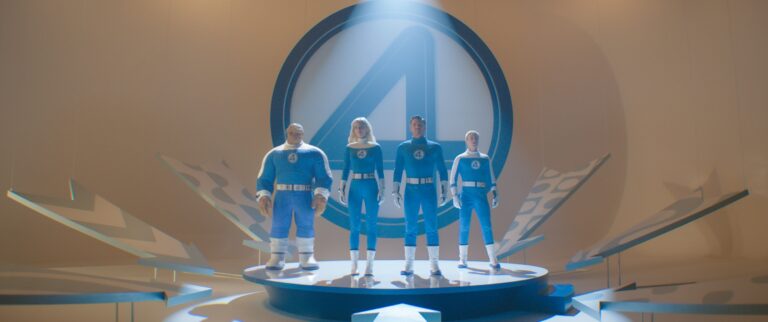
Helmed by longtime TV director Matt Shakman — recently of WandaVision, with which it shares many welcome stylistic sensibilities — this version of the Fantastic Four mythology is freed from the now-familiar constraints of the MCU. After several recent dalliances with the multiverse, we’re now fully entrenched on an entirely different Earth (number 828, for those keeping track). Unlike our MCU’s Earth, overcrowded with superheroes, rattled by temporary mass extinction events, and polarized by the political fallout of having a president who turned into a Red Hulk and nearly started a world war for control of ancient alien technology, Earth 828 is pretty damned quaint. A retro-futuristic forever 1960s, this Earth’s people have retained a boundless optimism and civic cohesion. Having watched decades of Marvels, you can see why they’re so cheery.
Dispensing with the typical origin story, the film instead opts for a literal highlights reel of their backstory via an old-timey talk show. In short: four years prior to the action of this film, a scientific super genius, his lovely wife, her brother, and their best friend took a rocket ship into space. Some cosmic rays bombarded them, gave them gnarly superpowers, and they’ve been saving the world ever since. This is a planet whose population knows only four superheroes, and the ones they’ve got are so impressive, good natured, trustworthy, and telegenic that their mere presence has ushered in a golden era of rapidly demilitarized world peace. The New York City looks vaguely familiar, albeit with some sleek new buildings, a rocket launching pad, and a whole lot of Space Needle inspired architecture all over the island.
Working from a screenplay by Josh Friedman, Eric Pearson, Jeff Kaplan, and Ian Springer (with an additional “story by” credit to Kat Wood), Shakman situates the film squarely in the heart of this fantastic family. We meet them in their fabulous home atop the Baxter Building, all pop colors and curvilinear architecture. Reed Richards (Pedro Pascal), he of the big brain and stretchy body, finds out that his wife Sue Storm (Vanessa Kirby), whose powers involve occasionally becoming invisible, telekinesis, and brokering world peace, is unexpectedly expecting their first child. Two soon-to-be cool uncles, Ben Grimm (Ebon Moss-Bachrach behind a million pounds of CGI orange rocks in a character that’ll probably never make sense on film) and Johnny Storm (Joseph Quinn), figure out the secret before family dinner is even served by the cute little do-it-all robot helper named HERBIE (not naming it Kirby as a tribute to the series creator seems like an odd misfire). They have a nice dynamic and telegraphed familiarity that plays like a classic sitcom.
For a brief stretch, neuroses over getting the house ready for the incoming bundle of joy (and anxieties about whether the kid will be superpowered) are their biggest concerns. Pascal is pretty charming as a nervous professorial type anticipating his first kid. Kirby projects confidence and calm empathy as an expecting mom. Whether you buy into them as deeply in love, they’re at least committed to the bit of new-onset parents. Moss-Bacharach and Quinn have less to do, largely because any prickliness of their characters’ personalities have been polished away in favor of a general purpose perpetual niceness. Sure enough, these domestic worries are displaced by a crazy lady on a surfboard descending on Times Square to herald the impending end of the world. In our Earth, this kind of stunt would barely merit mention. But here in Pleasantville, a silver-skinned lady (vaguely resembling Julia Garner) slicing through the night sky and announcing, in a hypnotic singsong lilt, that the clock is ticking to make peace with their loved ones before their planet becomes an afternoon snack from a giant space god makes quite an impression.
Soon, Earth’s only heroes are off to space to investigate Galactus, a mysterious godlike man whose planet-eating habit is the source of their impending demise. A long, dull voyage into deep space sets up a terrible choice from a very hungry space man who would like to see the baby. A daring interstellar chase sequence features a flyby of the Inception black hole, a kind of trippy but underdeveloped shootout in a wormhole, and a very odd swing at finding out how birthing works in zero-G. In the end, their refusal to surrender to the most extreme formulation of the trolley problem sets up a second half of the movie that’s largely about PR and disaster prepping. Sue embraces motherhood and negotiates deals with Mole Men. With little else to do, Ben engages in the gentlest flirtation with Natasha Lyonne at a synagogue. While Reed waxes about Archimedes and scribbles on his incredibly stylish chalkboards, Johnny finds himself increasingly intrigued by a deep dive into the sexy surfer girl and her back catalog of indie records.
In almost every way, this latest entry clears the low bar of being better and more competently executed than its predecessors. But let’s put that in context. The first adaptation was Roger Corman’s now-legendary rights-grabbing B-movie, available only in samizdat B-movie style. The next two, under the custody of 20th Century, at least gave us Chris Evans as a flaming f-boy Human Torch (somehow he recovered and made a second life for himself in the MCU as Steve “America’s Ass” Rodgers). Josh Trank’s swing at the franchise was widely panned, but I respected that he firmly engaged with the body horror inherent in finding oneself with cosmic ray-induced rubbery bones, skin that catches fire, or being permanently transformed to being made entirely of orange rocks. (Maybe the real problem with this franchise is that their powers aren’t that great and are mostly really disgusting?). This one is far classier and better looking than its predecessors (with fellow WandaVision alum Jess Hall as cinematographer), but everything but the glimmering surfaces also feels muted.
It’s an interesting choice to try to situate the film’s core conflict in the family. Within this framework, Pascal and Kirby mine the thin script for some meaningful interpersonal beats, but passions and drama there remain muted by their characters cerebral dispositions. A downside of focusing on the marital tensions of raising a baby while trying to solve a crisis via equations that there’s little in the way of astonishing feats along the way to spike excitement. For long stretches, we could easily forget that they’re superheroes. Aside from a few gags, the film barely remembers that Reed Richards is elastic-limbed Mister Fantastic. No matter how many sweaters he wears over his bulging orange rock body, we can’t forget that Ben Grimm is The Thing but his biggest flex is joking around with neighborhood kids. Maybe we don’t see much of Johnny Storm as the Human Torch because the CGI they decided on for his “flame on” transformations tilted closer to emo camera filters. And Sue Storm’s power is turning invisible, which is used for one super-weird effect early in the movie and then kind of set aside in favor of some force fields later.
All of this attention to the people vs. their powers should make room for deeper character development, but that doesn’t really pan out for heroes or villains. The family dynamic is mostly stable and we barely get to know the distant bad guys. Unknowable evil can be very scary, but the Surfer and Galactus barely register as a dramatic counterpoint. When they finally arrive, the climax is more like an awkward walking tour of the city with an unwelcome guest who’s making strange unreasonable requests than the precipice of the end of days.
For as good as the movie looks — it’s as if someone finally gave Wes Anderson a superhero franchise — its plotting never matches the whiz-bang look and feel of this alternate Earth. Maybe it’s the parallel universe dynamic that lowers the stakes since a mid-credits scene from Thunderbolts* pre-drained any uncertainty about the destination for this franchise. Maybe it’s that everyone on this planet is just so gosh-darned nice and agreeable. But for a movie with compelling actors introducing a whole new world and set of brand-new superheroes as they try to save their home planet and their beloved family from annihilation, it’s puzzlingly plodding. In a way, I feel bad about complaining: it’s nice to have a movie with the temperature dialed down even in the face of an apocalypse. While it’s blissfully unburdened by homework assignments, callbacks, or setups, it’s also so important to the future of the MCU that you can feel the Goldilocks gravitational pull of getting this one “just right” having prevented the film from being either terrible or delightfully outstanding. Like it’s alternate Earth, it’s perfectly pleasant, but its hard to escape the nagging sensation that we’ve already seen the most infinitely entertaining and accomplished version of this back when it was called The Incredibles.
Fantastic Four: First Steps arrives in theaters on July 25th
Lead image courtesy of Marvel Studios