

Anemone (2025 | UK, USA | 126 minutes | Ronan Day-Lewis)
Most adult sons have to contrive ways to hang out with their retired dads. Catch a ballgame, a weekend getaway, get wrangled into helping with household projects. But when your dad is one of the most celebrated living actors on the planet and you’re a burgeoning film director, there’s another more clever option available. Spend lockdown writing a script together and then trick your dad out of retirement to go Method and make a movie with you out in a remote cabin in the deeply forested countryside.
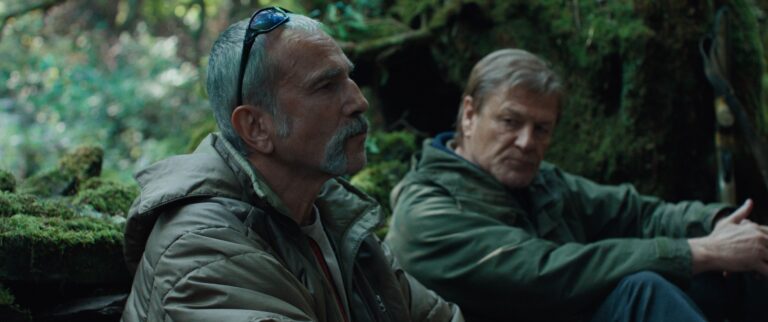
While he could be accused of pulling a nepo-baby move, Ronan Day-Lewis has to be commended for getting the world at least one more electrifying performance from his father, Daniel Day-Lewis. Opening with a series of children’s drawings depicting the Troubles, Anemone brings DDL back on screen as Ray, a reclusive soldier whose decades of self-isolating breaks with his past, family, and religious upbringing are upset by a visit from his long-estranged, still devout brother, Jem (Sean Bean) on the occasion of a family crisis back home.
Both actors are predictably terrific, but it is Daniel Day-Lewis’s show. Lithe and weather-worn, he convincingly plays the former army engineer who disappeared from the world and hasn’t looked back. As the motivating plot and backstory slowly reveal themselves as the stoic brothers slowly reacquaint themselves in the dense woods of Northern England (a Welsh cabin stands in), the film’s raison d’être (and reason for the cost of admission) is the three titanic monologues it gives him. Illuminated by candlelight and flickering fires, he relates stories of fantastic retribution and life-altering wartime decisions with such effusive magnetism that the images conjured purely by the potency of his performance are more vivid than anything actually projected onto the screen. Who needs historical re-enactments or flashbacks when you have the potency of a story brilliantly told? It’s among humanity’s greatest special effects on breathtaking display.
For many, these scenes alone will make it worth hanging around through some characteristic tropes of a first-time feature filmmaker figuring things out. A successful visual artist, Ronan brings a painterly eye to the look and feel of the movie. Wide shots marvel at the wind cutting through dense forests and through the coastal dunes. Close shots often distort their subjects, be it dinners or faces past the point of recognition. The set design of the isolated cabin conjures a fully realized abode, functional yet homey. The look of the film is stunning, both the blue and green saturated natural world and shots like one of the brothers crossing through a small town carnival which seemingly exists because the film was crying out for a touch of color. He also conjures breaks from reality, magical interludes where otherworldly visions intrude.
It’s in these that one feels a new filmmaker relying on style to make an impression but struggling with pace and important mechanics. A distorted post-rock soundtrack from the Haxan Cloak frequently drowns out the sonic environment before cuts to near silence for dramatic emphasis. It works once, but becomes repetitive as the film approaches its full two-hour running time, much of which is spent observing the men’s terse-to-silent interactions — splashing in the sea, bathing in a lake, drunkenly dancing in the cabin, or coming to blows outside. It’s rendered beautifully, but the revelation of the underlying plot unfolds at a frustratingly slow pace. The full measure also, unfortunately, is a hallmark of so many “written during lockdown” scripts which suffer from the insularity of the era. The issues obviously feel big to the people in the movie, but the screenplay struggles to convey the necessary richness beyond its few showstopper moments.
It doesn’t help that the cuts back to Jem’s home and the crisis that motivated his desperate outreach to his brother are wet blankets of bleakness. There, his partner Nessa (Samantha Morton) is left to deal with her son Brian’s (Samuel Bottomley) emotional withdrawal and career catastrophe. Morton is herself among the greats and is given a spotlight to remind us of why, but it comes late in the film and as a muddled series of explanations. When you’re ninety minutes into a film and a character has to ask “How much do you know about The Troubles in Northern Ireland?” you know that something has gone a bit off in the pacing. Such is the overall structure of the storytelling: so much slow build and then a hasty supernaturally achieved resolution.
When the end comes, it feels both rushed and overdue.
It leaves a lot to be desired, but no regrets for having witnessed an unfortunately rare acting showcase from some of our very best.
Anemone arrives in theaters on October 3
Photo courtesy of Focus Features