

Springsteen: Deliver Me From Nowhere
(2025 | USA | 119 minutes | Scott Cooper)
Who was it that said “All unhappy rock stars are alike; no happy rock star has ever truly existed in the history of this Earth?” Probably the same esteemed writer who famously pondered “War, what is it good for?”
So it goes. Into every awards season, a musical biopic is born, and this year, Scott Cooper takes his turn at telling the story of one of the remaining living legends of the rock canon on the big screen. The result is a film of sturdy competence and surprising focus, here telling the story of Bruce Springsteen through an adaptation of Warren Zane’s history of the making of Nebraska.
As with all of these kinds of films, it’s nearly impossible to depict the creation of a great work of art without seeming anything less than inevitable in the rearview mirror of history. To an already reverent audience — or even one with the faintest sense of musical history — the splendor of the songs and their depth of feeling is essentially self-evident, so the pleasure rests entirely on witnessing a facsimile of their creation. With the famously insular Nebraska, a bedroom recording made in the hollow, dark comedown from ascendant fame, it’s an especially tricky proposition.
To that end, Cooper opens the movie with a rousing finale of the Boss’s “Born to Run” tour, all sweat and growls, a full band basking in the fruits of their creation, and a packed audience, sweaty with adoration. That’s the last you’ll see of the E Street Band or of the arena rock that’s become synonymous with Springsteen. Instead, he retreats into the serotonin crash in a lonely rental house in Colts Neck, drives his flashy new car into Asbury Park, where he drops into jam at the Stone Pony, and contemplates the working world around him and scribbles notes on What It All Means.
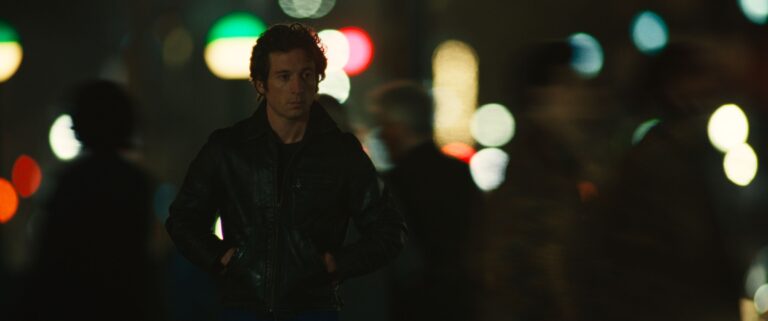
Luckily, no one aside from Springsteen himself wears a white T-shirt, weathered flannel, or signature leather jacket quite as well as Jeremy Allen White. His singing is also very credible; so after that big introductory showstopper, with his studied posture, facial ticks, and vocal growls, dark contact lenses, and affectations, the performance fades to a kind of naturalism, and it’s easy to enter the liminal state of acceptance that we’re watching an interpretation rather than an attempt at facsimile. White’s a strong actor, and he easily ascends beyond the genre’s tropes and sweaty mimicry to find some glimmers of deep truth about writing an album as a cry for help.
In the intimate moments of Masanobu Takayanagi’s muted cinematography, it’s easy to believe that he’s channeling something big and powerful and only reachable in quiet moments of near-solitude, finding inspiration in Badlands on a little television or Flannery O’Connor stories on his bookshelf. Plucking away at demos in a dark bedroom with only Mike Batlan (Paul Walter Hauser in rare restrained form) and some wobbly recoding equipment as witnesses, the acts of creation feel genuine and privileged.
So it’s perhaps a shame that the film insists on being bigger than these lighting-in-a-bottle moments. There’s an unfortunate reliance on literalism and frequent flashbacks to a troubled relationship with a highly troubled father. These are shot in black and white, featuring Stephen Graham as a menacing, sometimes abusive, alcoholic father and a child actor (Matthew Anthony Pellicano) as young Bruce. There’s nothing wrong with them or their performance per se, but for me it’s a case of showing too much and not telling enough. I’d much rather hear Jeremy Allan White tell someone a story of his bad dad and wrestle with his competing feelings of duty, love, and anger than to see it played out as re-enactments, spliced in to emphasize obvious points.
Even less successful is the insistence on including a spotty romantic relationship with what’s been explained as a composite of Springsteen’s unsuitability as a stable partner while in the throes of songwriting. Odessa Young plays the role of Faye, a single mother who meets Bruce after a show and is too bewitched by his charisma to see that the relationship is a dead-ender. Their moments together have a sweetness, but everyone with eyes knows that her character and her ultimate disappointment are yet another unnecessary distraction from the main events. Other minor characters and moments feel even more spliced in to make points.
The film is mainly about the making of an album, but it’s also a study in depression. It’s admirable visibility into the darker strains of anrtistic life. Unearthing this dynamic benefits from having Jeremy Strong playing longtime manager Jon Landau. In a well-welcome warm turn, he commits to a terrible haircut and a modest amount of screen time to play someone who fiercely defends Bruce’s creative process, insulates him from the demands of burgeoning stardom, and who’s attuned to his tenuous hold on mental health. Although there are many challenges in making the album, from the technicalities of recreating a bedroom aesthetic in the studio to the record company’s hunger for a string of hits, the most prickly parts are smoothed over by a foreknowledge of how everything will work out in the end.
With Springsteen and Landau involved in the production, Cooper’s work is more dutiful than adventurous. It hits all the marks and is a platform for Jeremy Allen White to turn in some strong interior work rather than doling out a string of easy adrenaline hits in the form of concert reenactments. Nevertheless, a film like this is right in the sweetest of sweet spots for a Telluride crowd, and the audience ate it up. It didn’t hurt that the Boss himself made a surprise appearance in town to introduce the film to rapturous applause. Whether it calls for an encore is another question.
An earlier version of this review ran as part of our coverage of the 2025 Telluride Film Festival, where Springsteen: Deliver Me from Nowhere had its world premiere.