

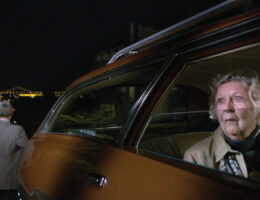


Sentimental Value (2025 | Norway | 133 minutes | Joachim Trier)
It’s been quite a year for films about fathers reckoning with the consequences of having prioritized careers over family (see also: Jay Kelly, Hamnet, La Grazia; even a bit of The Mastermind, sans the introspection) or making art as a balm for old wounds (Hamnet, Springsteen: Deliver Me From Nowhere). None yet have come close to holding a candle to the carefully crafted emotional effectiveness of Joachim Trier’s exquisite Sentimental Value.
The story of a family of depressives told through the lens of a picturesque Oslo home (a marvel of production design) finds Trier once again working with Worst Person in the World breakout Renate Reinsve. She plays Nora, a celebrated stage actress with a few television series successes under her belt. As the film opens, she’s contending with a too-common bout of panic that nearly prevents her from taking the stage for a modernized production before a full house on opening night at the National Theater. With chase sequences, slaps, and passionate kisses as remedies, her stage fright and feelings of constriction are treated with both seriousness and comedy.
The show goes on, and we find out part of what’s been weighing on her mind. Her mother’s death after a slide into dementia means that the beloved family house, passed through generations, is now empty. With neither her nor her sister in a position to take it on, its fate is uncertain. Soon, though, their long-estranged and often absent film director father, Gustav (Stellan Skarsgård), unexpectedly arrives with intentions to make a new film in the family home.
His return to their lives proves unsettling in and of itself, even moreso is his desire to cast Nora in the lead role of his film. Her instantaneous refusal to participate and steadfast resistance to his fleeting charms speak volumes. The magnetic push and pull between them speaks volumes about their troubled history of betrayal and failed expectations. With Nora’s steadfast avoidance of him and skepticism of his project — she won’t even look at the script — he soon finds another muse for the part. At a film festival where he’s being feted with a lifetime achievement retrospective, he encounters Rachel Kemp (Elle Fanning), an American superstar admirer looking to make more meaningful work. Their chance meeting (at the Deauville Film Festival, which has a focus on American cinema, a great little joke) ends with a magical sequence on the beach that lands her a part as a stand-in for his daughter.
Trier’s prismatic story is an intricate yet sturdy construction. As the year proceeds through closely observed episodes, our understanding of each character in this portrait of a wounded family deepens. As we see her move through the world, Reinsve portrays shimmering insecurities beneath Nora’s guarded facade long before they spill into crisis. Skarsgård’s turn as Gustav is one of breezy confidence and a need for cheerful control in reaction to a long-buried crisis of abandonment in his own childhood. These are characters who can barely speak to each other, so the idea that they could work together even in the constructed reality of a film production — let alone an autofiction about his own mother’s demise — speaks to a father’s wishful thinking about the power of moviemaking or an obliviousness to the depths of his daughter’s self-preserving anger.
This, the brilliance of the device of bringing in a stand-in. Stepping in between as an avatar, Elle Fanning inhabits Rachel with a keen sense of herself, a longing to pursue greatness, and a nagging sense that she’s not right for the part. Amid titans of Scandinavian cinema new and old, though, Inga Ibsdotter Lilleaas was the film’s most shimmering discovery (to me). As Nora’s sister Agnes, she represents an anchor of relative normalcy outside the world of cinema as a researcher, wife, and mother to a sweet blond son (Øyvind Hesjedal Loven) and serves as the accommodating daughter whose gatherings bring the family together.
From exceptional production design, an inviting piano-forward score from Hania Rani paired with a deep cut needle-dropping soundtrack, and the light, airy, naturalistic cinematography of Kaspar Tuxen Anderson, Trier creates a whole world. Here, though, the team flexes beyond the confines of present-day Oslo to imagine the family home over time and investigate the deeper history of traumas at the heart of their family as they work through their own struggles. Nora takes on a new play and relationship tumults with a colleague (frequent Trier collaborator Anders Danielsen Lie). Gustav’s movie hits road bumps as he tries to rekindle the past and make it work with the wrong actors, turning to the drink as his emotions. Agnes guards the normalcy of her own family as a correction from her own childhood. They don’t always share the screen but there’s a powerful interconnectedness.
With its anthological qualities, structural mirroring, and character reflexivity, it is a very artsy movie about artists making art to work through (or avoid working through) their persistent depression. So perhaps it’s not altogether surprising that as it’s made the rounds, I’ve seen some reactions that found the film overly filigreed, too literary, or distancing.
To those people, I say congratulations for whatever family and personal lives have brought them to that point in their lives, be it perfect families, great relationships, or incredible therapy. To me, though, this sort of work — with its precise storytelling, formal constraints, and ability to balance focus between characters and spanning time — is akin to Wes Anderson’s greatest confections: in which structures, conventions, and strong artistic sensibilities create a safe space for interrogating deep emotions, confronting lingering pain, and occasioning opportunities for catharsis.
This stuff is right up my alley, and having seen it a couple of times, cements it as easily among the best of the year. Joachim Trier constructs his drama about the hard business of family to unfurl with such precision that you barely notice what it’s up to until it swoons to full bloom and bowls you right over. A tremendous gift of a film.
An earlier version of this review appeared as part of our coverage of the 2025 Telluride Film Festival, where Sentimental Value had its U.S. Premiere. The film enters wider theatrical release this weekend, including an ongoing run at SIFF Uptown.
Lead image courtesy of NEON.