
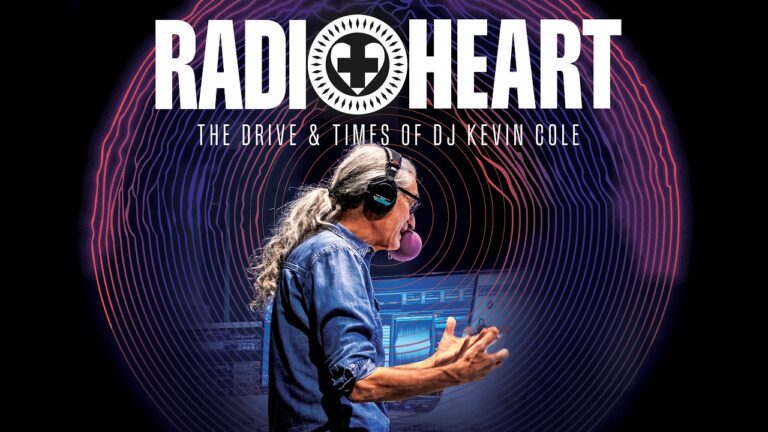
One of the most popular films to play at the Seattle International Film Festival this year was a locally produced documentary about the career of legendary radio DJ Kevin Cole. It sold out its first two screenings, and a third was added due to popular demand, which also quickly sold out.
The hometown connection is obvious, but I think the reason this doc connected with audiences is because, frankly, it is just really good. Kevin Cole makes for a compelling subject because he has an uncanny ability to bring stories out of musicians who are used to answering the same questions over and over again. Plus, he has been a pivotal figure in music for more than fifty years, usually present at the moment of creation. He helped launch the influential Minneapolis music venue First Avenue, ran an innovative radio station that gave DJs complete autonomy over their playlists, and then moved to Seattle, where he helped launch Amazon’s music service before joining KCMU prior to its transition into KEXP.
I met up with directors Peter Hilgendorf and Andrew Franks at the KEXP Gathering Space for a wide-ranging, hour-long conversation. This interview has been condensed and edited for clarity.
Let me start with the genesis of this film. How did it come about?
Peter: I’ll start with this: I’ve known Kevin since back in the Minneapolis days. When he was at the radio station Rev 105, I was working at a newspaper, and we were planning to collaborate. Then all hell broke loose at Rev 105. A year or two later, I moved to Seattle and got a call from him saying, “Hey, Amazon’s going to start selling CDs on the internet.” That was exciting.
I convinced him that Seattle would be a great place for him. He wanted to know about record stores, clubs, and the radio scene (specifically if KEXP was for real). I assured him it was. I was playing in a band, working at Easy Street Records, and going out to clubs all the time. I told him, “The worst thing that happens is you leave after a year. You help Amazon get off the ground, and then you find a radio job.”
He loved Seattle, and he loved early Amazon because it was packed with absolute music freaks. He met his match with people who wanted to talk about classical, jazz, avant-garde, and country music around the clock. But radio is what Kevin truly loves. Throughout his career, he and I would constantly collaborate on fun, transitional projects for KEXP pledge drives. I was always a hard yes.
When it came time for him to step back from full-time drive time, he asked me what he should do. I suggested a ten-minute thank-you video for YouTube featuring Kevin and a few of his former bosses: Steve McClellan from First Avenue, Jen Cast from Amazon, and Tom Mara from KEXP. That was the original plan.
But during the interviews, those three wouldn’t stop talking because they kept telling these incredible stories. The camera and sound crew were wrapping up and saying, “I didn’t know Kevin did all that! How are you going to fit this into ten minutes?” I realized how deeply his former bosses saw his impact. Suddenly, we were looking at a twenty-minute story, which snowballed into 15 or 20 interviews. I asked Kevin, “How do you feel about a short film?” He asked, “Do people care?” I told him, “Everyone helping who doesn’t even know you is digging this, so yes.”
Jen Cast pulled me aside and noted that we’d need to raise money to hire a proper crew and make it really good. People came out in droves wanting to fund his story. Then the race was on. Footage was rolling in from out of state. I called Bob Mould’s manager, and thirty minutes later, Bob was in.
I got great advice from filmmaker Brian Lindstrom, who told me: “You’re making the movie for all the right reasons, but you need to find an editor who will save you from yourself. Otherwise, you’ll just include all the inside jokes you and Kevin love and miss the bigger picture.” Without that advice, it would have been a hot mess.
Like twelve hours long.
Peter: Exactly. I don’t have an ego about letting things go. I called Craig Brooks at Kontent Partners, a great video company in Seattle. He looked at the bones of the story and told me there was only one person for the job: Andrew Franks.
Andrew came on board in the fall of 2024. He looked at my beautiful mess of a rough cut and we really started editing in earnest by January 2025. Around that time, the Northwest Film Forum and Washington Filmworks came on board because they loved the project. Keeping it a hometown, all-Washington production team was a huge motivation. By then, Andrew had about 25 to 30 interviews to sift through.
Andrew: Originally, Peter and our producer, Rebecca Staffel, asked if I could do this in four months. I said it wasn’t impossible, but they came to me with a mountain of interviews that needed b-roll and archival footage we didn’t yet have. Only about 60 percent of it was shot when I started, so it ultimately took seven or eight months. Sifting through all those interviews was daunting. It was about navigating the scope without getting paralyzed by overwhelm.
I started by building what I knew. The first scene we put together was Iceland, because it was relatively simple. From there, we slowly picked off the interviews, took notes, and figured out which characters were shining through to tell the story. Along the way, Peter and Rebecca asked me to jump on as co-director.
Peter: He earned it.
Andrew: Editors aren’t always credited as co-directors, but with documentaries, so much of the film’s vision is truly found in the edit. I had never met Kevin before, but everyone I knew spoke so highly of him. I’ve never heard a single negative thing about him.
Peter: Honestly, that was a challenge. There was a version of the film where every single person just said, “Kevin’s incredible! I love Kevin!” But you want to barf if it’s just that. That’s not a movie. It’s just…
Hagiography.
Peter: Hagiography is exactly the word I did not want applied to our film.
How open was he about his struggles?
Peter: That was a struggle. He knew he needed to go there, but Kevin’s perspective was, “That stuff was back in ’88. I’ve been sober ever since and never relapsed. Why make it the focus of the film when I’ve done so much cool stuff since?”
Through the process of watching other documentaries, he came to understand why it was important. To capture those deeper moments, Andrew used some great directing techniques, like going tight on him or shooting on an old VHS camcorder to give it an intense, internal monologue feel.
Andrew: We were having a tricky time getting him to drop his guard and not give prepared interview answers. To get the deeper stuff, we tried a technique where we simulated a radio environment. We put headphones on him, had him talk directly into a mic, and made it so he couldn’t see who he was talking to. That loosened him up enough to get the connective tissue we needed for the film.
Peter: Meanwhile, the rest of us were literally laying on the floor of his home studio hiding behind boxes, whispering intense questions.
He was very conscious of his image. He said, “Yes, I struggle with depression and I have my meditation practices, but I don’t want people to think I’m just some depressed guy.” We told him, “Kev, nobody thinks that. Showing people that you actively work on your mental health sends an incredibly positive message.” He was down for it after that.
One of the things I took away from the film is that he became a vessel for other people to tell their stories, like his moving interview with Brandi Carlile about being disowned by her church when she came out.
Peter: Kevin is brilliant at getting people to open up. His feature Music Heals is all about encouraging that vulnerability. Yet, he sat on his own story for years. We were so lucky he finally shared it, and he didn’t just gloss over it; he got into the gritty details.
He never wanted to glamorize it. It was incredibly important to Kevin and to us that this didn’t feel like a VH1 Behind the Music episode that glorifies drug use. We wanted to take it seriously to show people that you can push beyond addiction, even when it’s incredibly difficult.
The one minor “flex” we included is a shot of a New York Dolls album signed by Johnny Thunders that reads, “Hey Kev, thanks for the fix.” That’s the most stylized version of it. If you’re going to be a bad boy, doing it with Johnny Thunders is as far as you can go.
I don’t think you glamorized it at all. I remember his partner, Shawn Stewart, speaking early in the film about how difficult he was during his addiction.
Andrew: Yeah, she gave a great example of him ghosting her for days and then casually showing up with beer like nothing was wrong. Say no more, because the audience immediately understands that dynamic.
I want to ask about what I thought was the big flex in the movie: when Prince asked Kevin to play one of his tracks while Kevin was DJing at a Minneapolis club.
Peter: Oh, yeah. That’s wild. We had two or three interviews of people recounting that night, and I knew it was gold because we could cut between perspectives and have Kevin wrap a bow around it.
Andrew: We knew it had to be a major scene, but as I edited it down, I realized just showing Kevin talking wasn’t exciting enough. We had incredible photos of Prince, but it didn’t match the epic nature of the story. I suggested to Peter that we animate the sequence. I wanted to give that legendary night the larger-than-life treatment it deserved.
Peter: It came together beautifully. I reached out to Pat Moriarity, a brilliant comics artist who used to work at Twin/Tone Records in Minneapolis but now lives here in Seattle. Because Pat is from Minneapolis, he knew Kevin, he knew the venue, and he could draw the vibe of the club straight from memory. He teamed up with our creative director, Eric Kassel, to animate it. It came out incredibly authentic. Pat knew exactly what records were stacked behind Kevin and what t-shirt he would have been wearing. Working with an illustrator who pours their own teenage memories into a project is a dream.
To me, the turning point for Kevin in the film was Rev 105, a great opportunity that ended abruptly when the station was sold and turned into a heavy metal format.
Peter: I was a listener back then, tuning in to Shawn on that final day. Andrew edited that scene beautifully. Interestingly, I expected Kevin to be deeply depressed about it in his interviews. He took it hard, but he refused to say it knocked the wind out of his sails. Instead, he dove into his journals and self-reflection. It pissed him off more than it dejected him, and he just leaned into his vision even harder.
Andrew: What made this film challenging from an editing standpoint is that it’s essentially the story of four or five startups across different eras. You have to give the audience enough context to understand the stakes. Rev 105 was particularly tough because it left a massive footprint on Minneapolis culture, but we had very little footage from the mid-’90s to show it.
Peter: We relied on a single promotional tape shot for a beer sponsor. It didn’t have booth shots of Kevin; it was mostly a promotional bus driving around ski resorts. But it did feature a shot of the Rev 105 sign and a camera walking into the elevator and up into the station. We stretched and used every single pixel of that footage.
So the startups were First Avenue, Rev 105, Amazon, and KEXP?
Peter: Yep, along with Music Heals within KEXP, and his work in Iceland, too. Going into this, I thought it would be a simple story about a guy obsessed with records. What we realized is that Kevin completely transformed these institutions.
First Avenue started as a disco club with swimming pools. We found old letters showing management trying to force Kevin to dress the staff up like the Village People. They actually fired him once for not having enough disco spirit. But Kevin knew disco wouldn’t last forever, and he pushed to bring in acts like The B-52s. At Amazon, they were a bookstore looking to break into music, and he built that audience. Later, Tom Mara wanted to transition KEXP from a basement college station into an influential FM and online signal. Paul Allen wanted the station to innovate with digital streaming tools. Kevin was the perfect tech-startup guy to poach for that.
He transformed these businesses, yet Kevin is the worst tech guy. He’s not a precision DJ; it pained him just to type in his digital ID. His true talent is cultural foresight. He knows where the hockey puck is going and skates to it.
The interview lineup was a murderer’s row of great storytellers: Jimmy Jam, Bob Mould, Jessica Dobson, Caroline Polachek. How did you narrow it down?
Peter: It was a simple formula: Who was there in the early Minneapolis days? Jimmy Jam and Bob Mould were essential. I knew Paul Westerberg would never do it, but Bob Mould was a pillar of the First Avenue scene. We needed Jimmy Jam to verify Kevin’s presence in the clubs with Prince. It took a year to schedule Jimmy, but we finally captured him in LA. He dropped a beautiful line: “People always remember how you treated them before they became a star.” That validated everything.
For Seattle, Jessica Dobson of Deep Sea Diver was a must because Kevin championed them early on. He similarly went all-in on Of Monsters and Men and Macklemore long before they blew up, and we had the behind-the-scenes footage to prove it. Kristin Hersh of Throwing Muses was another pivotal figure for the Rev 105 era. At the very last minute, a former Rev employee sent us an old photo album filled with pictures of Kevin alongside Frank Black and They Might Be Giants, which allowed us to match his audio drops perfectly with archival photos.
What I loved most is that the movie isn’t just about Kevin or the music; it’s about how someone finds profound human connection through music.
Peter: Exactly. Jessica Dobson and Caroline Polachek both noted that Kevin will pick out a hyper-specific element deep in a song and ask about it. Artists don’t expect that. They’re used to generic questions about tour dates and producers. When Kevin asks about a specific lyric change in the final chorus, artists realize he genuinely wants to understand their art. Ultimately, the film isn’t about Kevin; it’s about how he steps back to draw the audience closer to the artist.
Andrew: That was my biggest challenge entering the edit blind. Every artist kept saying how much they loved him, but I had to show why rather than just have them repeat it. I had to sift through decades of live sessions to find those unique, deep interview moments that would prove to the audience why his connection with musicians is so rare.
Tell me about the world premiere.
Peter: We premiered at the Minneapolis St. Paul International Film Festival (MSPIFF). That was incredibly important to us. We could have aimed for Sundance or SXSW, but Kevin is a hometown boy. After everything Minneapolis has been through, and having grown up there myself, I wanted this film to be a love letter to the city. The festival embraced us completely, and there was a marching band playing down the sidewalk outside the theater. We had three sold-out screenings there. Seattle International Film Festival (SIFF) followed suit, seeing the buzz we were generating on social media, and we sold out three screenings here as well.
Interviewer: Have you screened it for audiences in cities where Kevin hasn’t lived?
Peter: Not yet, because that’s our next big test. We know he won’t have a built-in hometown crowd everywhere. But we’ve already had viewers tell us they were dragged to the theater by a partner or parent, only to leave deeply inspired, moved, or in tears. That’s exactly who I edited the movie for: anyone. The most rewarding feedback is hearing from people who had no idea who Kevin Cole was, but walked out believing completely in what he stands for.
Radioheart just finished its run of three sold out screenings at the Seattle International Film Festival but you can check radioheartfilm.com or instagram.com/radioheartfilm for info on upcoming screenings.