
Once Upon a Time in Harlem
(2026 | USA | 100 minutes | Conceived and shot by William Greaves, Directed by David Greaves)
One of 2026’s most welcome surprises is a new film from the great William Greaves, the director best known for 1968’s Symbiopsychotaxiplasm: Take One who passed away in 2014. More accurately, Once Upon a Time in Harlem, finished now over a decade after Greaves’ passing, is a true collaboration between Greaves and his son David, who shot the film and completed the final product.
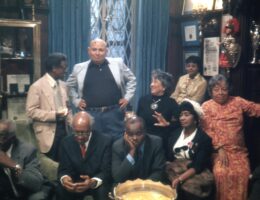
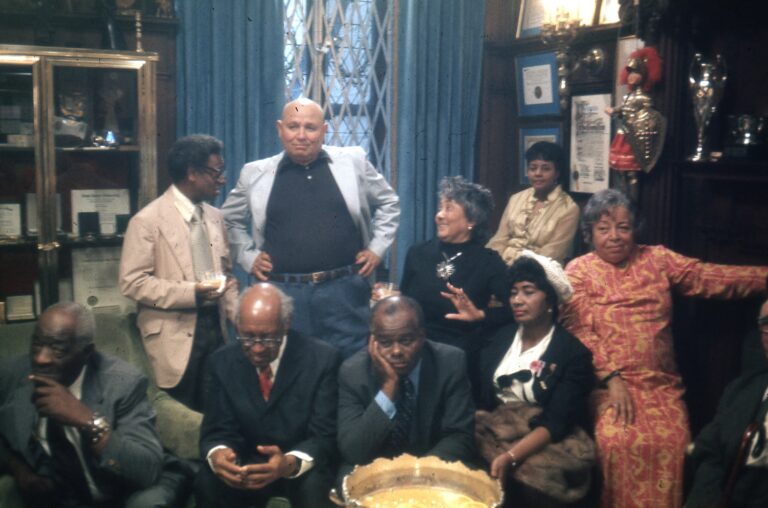
The film is built upon two interlocking concepts, each originating from a different Greaves. At the center is a party organized by William set at Duke Ellington’s house in 1972, reuniting the living luminaries of the Harlem Renaissance to reflect on their history, artistic lineage, and legacy. As a project, the party seems to split the difference between the self-reflexive construction of Symbiopsychotaxiplasm and the more observational mode of Nationtime, produced and released the same year as the events in Harlem, which captured the proceedings of the National Black Political Convention in Gary, Indiana. Nationtime, with its sprawling cast of Black public figures including Coretta Scott King, Jesse Jackson, and Harry Belafonte, was a conscious act of historical documentation, capturing a pivotal moment in Black history, not just the event and its key figures, but also the excitement around it, in the present tense. It’s a film that knows it’s immediately part of the historical archive, opening with a snippet from a speech by Richard Hatcher that “to understand where we are going, we must probe our bitter past”.
As a companion to Nationtime, Greaves’s party is an attempt at reanimating that past. Without direct access to the Harlem Renaissance, using his resources to capture the dynamics at this party is as close as he can get to time travel. It’s astonishing footage, tender, immediate, but also spectral in its obsession with the past and its foregrounded artifice, visible both in the constructed nature of the party and the bookended storybook sequences of participants approaching and exiting the apartment from the subway. Just as important as the people who are there (including Aaron Douglas, James Van der Zee) are the people who aren’t. When Countee Cullen’s widow demands Countee be discussed or the conversation turns to the women of the Renaissance, the discourse has the urgency of people holding the belief (not unfounded) their discussion will be if not the definitive, then at least a major text in the artistic and historical record.
This makes it all the more interesting that Harlem is just coming out now, over 50 years later. If William’s voice-over (which had some level of AI involved in its generation) is to be believed, it sounds like he didn’t know why he even shot the footage beyond an idea that it would be one of a series of co-creations, “great films on great people, all of whom are metaphors, creations of the godhead”. David’s involvement now is a clear progression on this initial concept, doubling the co-creative aspect and incorporating William as one of his own great people.
David’s treatment of the footage is best when he simply lets it run, quietly directing the images to create a sense of looking at the past, trying to see as much of this party as possible. The sense of recursive memory is the strongest near the end of the film, when we finally see the congregation gather around William for a series of group discussions about the disputed legacy of the Renaissance and contemporaneous Black art. The act of seeing figures from the past reminisce on a more distant past, and seeing them consider their own futures is moving in its own right, especially since these are such charismatic, intelligent presences, but it’s given immense weight because of the importance of the Harlem Renaissance. More than anything I thought of Linklater’s Nouvelle Vague, especially in its introduction of every individual with a name card, and like that film, it contains the palpable excitement of actually seeing these people in the same room. It’s a film for both Renaissance neophytes and aficionados, and like Linklater’s film, Once Upon a Time in Harlem movingly spotlights less prominent figures of the Renaissance right alongside its most celebrated names.
The film is less interesting whenever it cuts to still archival images, which is an intrusion for most of Harlem’s runtime. These images simply don’t look as good as Greaves’, and interruptions from some of the most beautiful portraits ever put to celluloid to upscaled black-and-white images make the film a somewhat disjointed experience both rhythmically and tonally. It’s hard to piece together a chronology for Greaves’ party or get a clear sense of the space when the edit cuts elsewhere in the middle of nearly every conversation.
These archival images, operating in a mode more akin to a Ken Burns, also underline the film’s pedagogical bent. It’s frustrating because these images are no better at actually teaching us about the past than just watching Greaves’s original footage. It’s cool that audiences can be introduced to Aaron Douglas’s paintings onscreen, but it’s frankly less informative than just a quick Google Search since the film isn’t really going into detail about who these people are. Harlem occasionally has the feeling of being told to learn your history, professing variations on the idea that “kids these days aren’t doing anything we weren’t doing 30-40 years ago” or that “they don’t know what they’re writing about”, a sentiment that’s understandable, especially in 2026, in the context of anxieties surrounding cultural legacy and declining literacy, but can also be grating.
William Greaves’s 1972 footage really does speak for itself though, and on its merits alone, Once Upon a Time in Harlem is a major achievement. There’s palpable history in these images, in the warm, effortless treatment of the celluloid, the participants’ aging bodies, and the content of the dialogue. The best parts of Harlem are a salve when seen alongside the flat, weightless images of the present, the revelation of this unreleased footage itself an embodiment of the idea that without hindsight, there can be no present sight or foresight.
Once Upon a Time in Harlem arrives in theaters on November 6 with local screenings at AMC Pacific Place, Alderwood, and at the Pickford in Bellingham.
Lead image courtesy NEON.