



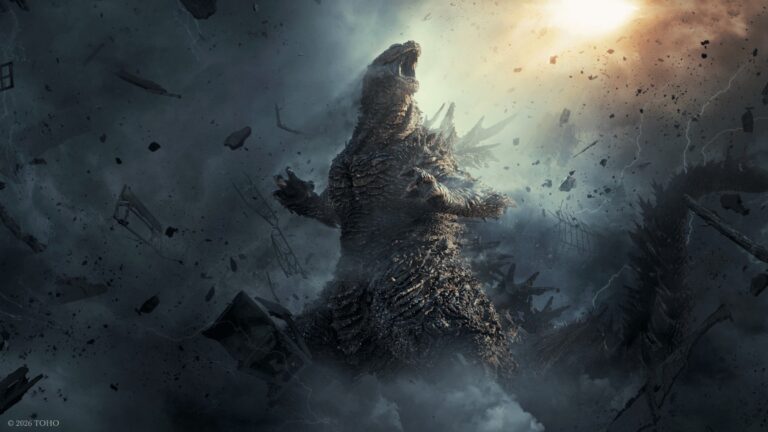
Godzilla Minus Zero
(2026 | Japan | 135 min. | Takashi Yamazaki)
A new Kaiju brings everyone to the yard. Rather than a typical review, a few of us had a debrief after a Godzilla Day screening of Godzilla Minus Zero, Takashi Yamazaki’s eagerly-awaited follow-up to Godzilla Minus One.
Josh: Just to set the stage since there are so many overlapping cinematic universes featuring our title here … Godzilla Minus Zero follows the action of 2023’s Godzilla Minus One. The film opens in 1949, years after the action of Minus One and gets right into it with a terrifying Kaiju attack, soon we’ll get re-acquainted with most of the characters from the previous movie as the reckon with the unsettling reality that the confrontation with Godzilla was only the beginning of Japan’s encounter with giant monsters.
Since this is a direct sequel, let’s get into the compare-and-contrast upfront.
Any initial thoughts about Minus Zero versus Minus One?
Tony: Godzilla Minus Zero, the brand-new follow up to 2023’s Godzilla Minus One, feels quite a few steps down from its predecessor in quality. However, it delivers the Wow moments in spades and plays in utterly breathtaking fashion on a big screen. There’s more than enough for fans of Japan’s biggest (metaphorically and literally) pop culture icon to love here.
Morgen: Right off the bat, I’m with Tony in mentioning the first installment was heads and shoulders above the sequel. It’s just lacking in places that Minus One wasn’t like intriguing character arcs. There were some really fantastic monster moments and the special effects did not disappoint, so a few aspects I really loved from the first in the series kept me happy in the second.
Josh: My memory of Godzilla Minus One is admittedly fogged by the passage of time but I remember it as being a really wonderful surprise when it stomped onto our shores in 2023. The style and performances were throwbacks and it burst off the screen with the spirit of getting the gang together in the immediate endgame of WWII combined a spirit of camaraderie with real historical context.
Tony: Godzilla Minus One, simply put, felt like a breath of fresh air for the franchise. Its great success hinged on it being an involving historic drama and character study…whose antagonist happened to be a giant, fire-breathing, radioactive lizard wreaking havoc on Japan. The human element clicked so famously, it even worked like a charm on kaiju civilians (for the uninitiated, “kaiju” = “Giant Monster” in Japanese). And the visual effects, spearheaded by director/co-writer Takashi Yamazaki, represented a real high-water mark for the franchise. It rated high on my personal Top 10 List that year.
Morgen: Agreed both Josh and Tony. It was also higher in my top 10 for 2023. As the anticipation was building for Minus One I was worried that it wouldn’t capture the nostalgic feel yet taking itself serious enough and topping off with a huge dollop of campiness that the originals held for me. I was absolutely thrilled with Yamazaki’s creation. It’s so rare to have a love for films in your youth and find a new addition meeting or exceeding your expectations, but this was one of those rare beautiful moments. The effects were taken more seriously than the old days (well, technology will let you do that), the characters and storyline were stellar and the focus was more on individuals rather than villages or cities as an abstract.
Josh: Godzilla Minus Zero really digs into the lingering pain of a society in the aftermath of a global and monstrous context. To an extent, this makes it substantially less fun as we sit with the characters and their scars literal and metaphorical. It’s not a subtle metaphor, but it’s really hard to move on with your lives when giant creatures keep emerging from nowhere to stomp all over your cities.
Tony: Godzilla Minus Zero, by contrast, feels a lot more like a traditional Godzilla movie, with all the pluses and (pardon the pun) minuses of the subgenre. As is the case with a lot of sequels in general, there’s an assumption that we know the recurring characters well enough to not need as much backstory or nuance this time out. That does mean they’re often downgraded to delivering kaiju progress reports and a LOT of exposition. There’s some fun for longtime Godzilla fans in this, but a little goes a long way. Big G gets a formidable monster adversary in the flying, laser-beam-spitting Ghidorah, so yes, monsters do brawl in grand fashion.
Morgen: Minus Zero‘s attempt along the same lines fell short, it was too much like the first to be interesting, especially in character throughlines. It’s almost like they got lazy. Someone I chatted with mentioned that if the family from the first film was taken out (and maybe a couple new characters were introduced instead) it would have been so much better and I have to agree.
Tony: The most entertaining kaiju films either craft human characters you care about, or go so batshit nutty that the exposition hits untold heights of near-exhilarating goofiness. Minus Zero’s non-monster moments get a bit too weighed down by earnestness without really providing the defined emotional core. As such, the pacing sometimes drags in a way Minus One managed to effectively sidestep.
Were you drawn in by a particular scene or performance?
Josh: Call me basic, but the best parts of this movie are the monsters. Ghidora initially arrives looking like an extra from Game of Thrones laying waste to a city while our trusty professor snaps some videos of the incident. I’d wondered what Drogon the Dragon had been up to since that series wrapped, good to see him getting work in historical dramas! From the jump, the scale and violence sets the stakes of the movie and it just keeps getting bigger and bigger.
Morgen: Exactly, where the first film’s big win was focusing on people, this sequel went bigger and badder with the monster fights. I mean, isn’t that why we were drawn into the original franchise in the first place? Maybe that was by design and they’ll do some kind of incredible storytelling that brings them both together in a third installment. Please bring back Gamera ,oh please oh please.
Tony: It’s hard to describe some of Godzilla Minus Zero’s biggest Wow moments in too much detail without broaching spoiler territory (GKids /Toho distributed an extensive list of situations and scenes to the press explicitly forbidding them from being divulged), but the very inventive and beautifully crafted action and destruction setpieces put most American would-be-blockbusters to shame.
Josh: Protip: when a space dragon’s happily taking a nap, just let the dude sleep. Every time the humans try to outsmart these beasts it turns out badly. There’s a tremendous sequence of an aerial assault on the sleeping Ghidora that turns into a chase through the mountain storm clouds that’s among the best action sequences of the year. The pace, editing, and effects are just breathtaking. Further, their seemingly ingenious attack on the sleepy critter has visceral and scary unanticipated consequences, awakening an even gnarlier situation for the unsuspecting villagers in his warpath. Once that beast has been woken, it’s clear that the we can only expect something great and that despite the conclusion of the previous movie, that something great is somehow or another going to be our old frienemy Godzilla.
Tony: One of the things I appreciate about both of Yamazaki’s Godzilla movies is how singularly Japanese they are. Notions of humility, altruism, and self-sacrifice embed themselves deeply in Japanese culture, and it’s always a refreshing contrast to the wisecracking rugged individualists who populate most American fantasy/sci-fi blockbusters.
Morgen: Tony, this is precisely why this version of the franchise is so affecting and works so very well. Godzilla is a Japanese invention and should remain that way. When folks brought it over for mass consumption in the States, it was hot garbage. No apologies there and I think most people we’d stop on the street would say the same. I think that’s why I loved the focus on relationships and the actual humans in the story of the first film. They hadn’t really done that in the original series, but it felt consistent even so and brought about even more of the unique cultural touch into the mix.
Josh: Every sequence with the monsters is aces. I’m of the mind that Godzilla’s always some sort of hero; so it’s always a thrill when she (he? they? I do not presume to know Big G’s pronouns) shows up to take care of business and the final confrontation does not disappoint.
Who do you think is the villain of the film?
Tony: Again, this requires some studio-mandated tiptoeing. To Yamazaki’s credit, his screenplay does spread the blame/antagonism out in a more complex manner than we’re accustomed to in American blockbusters. And without going into too much detail, the movie faces the physical and psychic scars of Hiroshima head-on, and it sets the stage for some not-ideal behavior as a result.
Josh: Fittingly, the answer to this is “it’s complicated”. The Americans are cartoonishly scheming and seem to exist mainly to set up future franchises. I loved seeing Min Tanaka ham it up as Kanji Murakami, wrestling with his trauma and flirting with the allure of exacting vengeance. As a visitor from outer space, Ghidora could have lots of metaphors overlayed on his unquenchable thirst for electricity and manically deployed destructive gravity beams. But it’s also possible that maybe he’s just a badass monster who wants to wreck stuff to feel alive.
Morgen: Yes! Murakami, while at first glance seemed cheesy and a little dopey in his portrayal, pulled through it to create a more complex and emotionally rich performance that I would expect. That’s another aspect of these films, just like the cultural touches Tony mentioned earlier, that American audiences probably won’t feel as deeply as those in Japan. We can’t appreciate the significance of this cast, they are all at the top of their game, it is truly stacked, which might be why they didn’t swap out the family for new characters. The chemistry amongst the actors and the performances they are capable of is something to behold.
Tony: Like its predecessor, Minus Zero also takes specific, laudible zero-fucks swipes at the United States in general. And if those swipes feel a little too cartoonish, the last year of the current US administration makes that cartoonishness look uncomfortably plausible.
For you was this a solid continuation of the new Godzilla franchise? Do you want to see the sequels continue?
Tony: Again, Godzilla Minus Zero feels a lot more formulaic than its near-masterpiece predecessor, but I still enjoyed it pretty thoroughly.
Josh: They’ve got a good thing going and this version of the franchise brings something totally different to the Kaiju lore that Legendary Pictures has been doing with the Monsterverse (and the increasingly labyrinthine lore explored on AppleTV’s admittedly enjoyable Monarch: Legacy of Monsters). The stilted performance style, direct engagement with Japan in the aftermath of the war, and outstanding heart-pumping effects make it worth continuing.
Morgen: I’m hoping that Minus Zero is a purposeful “lull” (though you wouldn’t know it with the fight scenes… so dramatic! So fun!) and a third sequel will really start bringing it together and show us why they chose the path they did in this second film. Again, bring on Gamera! I am desperate to see that rocket-propelled turtle in action again.
The first one was a definitely character study more than a monster movie, do you feel that thread continued in this one? Did you connect with the characters?
Tony: Kinda sorta. Minami Hamabe’s and Kôichi Shikishima’s embattled romantic couple built up so much goodwill in Minus One that it helped reduce the ache of them just not getting as much emotional depth this time. But the rest of the ensemble that felt so cracklingly real and affecting in the previous movie gets pretty short shrift, and the movie suffers for it.
Josh: Indeed the human characters and sometimes excessive plotting are the weak point. Ryunosuke Kamiki (as Kōichi Shikishima) and Minami Hamabe (as Noriko Shikishima) are cute as the star-crossed couple. I admit that the twist that gives Noriko even more relevance to the plot was wacky and kind of fun and wish they’d gone harder into the implications of this not-to-be-spoiled revelation. I also loved the introduction of Masami Nagasawa (as Makoto Aoyama) in the role of a meteorologist savant who holds her weight alongside Hidetaka Yoshioka (as Kenji Noda) in leading the disaster response and planning. They’re all playing very broad versions of stock characters, though, so I can’t say that I really connected with them on a deeper level.
Morgen: We’ve hit on this quite a bit earlier in the chat but agree again with the fellas, I think they were dragging on with the story of the leads from the first film too much. If they focused more on the mad scientist Murakami (we really only got a brief taste of his capabilities), Noda as the fallible guy in charge, or even the idiot American soldiers (though, leaving their character development hella shallow is a solid choice), I think it would have made the story richer. Just leave the main family in peace and quiet to live out their days. Introducing a new character that hadn’t been through the horrors of war or Big G (I love that nickname guys!) would have made me feel less emotionally exhausted.
Final thoughts on the film as a whole or anything that ended up annoying/angering you?
Tony: For all its flaws, Godzilla Minus Zero still represents a solid continuation of the franchise. That I want to see it again, on the biggest screen I can, represents a pretty hearty endorsement overall.
Josh: As much of a monster as it makes me, the balance of screen time given to an admittedly very cute kid (Sae Nagatani as Akiko) vs. super awesome Kaiju was not what you like to see. There’s just way too much of cloying and crying in an often repetitive storyline that whose point could’ve been made with much less effort. The same could be said about the rest of the human response; I would’ve been happy for a tighter edit to the plot that gives us smaller doses of the humans, and much bigger gulps of the monsters.
Morgen: Josh, to your point, I felt drained after hearing her cry for nearly two straight minutes, especially after she had run-ins with the kids at the orphanage who were jealous and heartbroken that she had a family to go home with. That kind of overrun sense of guilt, and emotional over-indulgence when it doesn’t do much to push the story along isn’t fun for me. It’s bad enough when I’m overwrought for good reason… don’t pile on.
Josh: Maybe my gripe is that I have seen Shin Godzilla, which achieves masterwork status in the way that it turned a harsh examination of complacent bureaucracy into the real enemy alongside some of the craziest Godzilla variations put to screen this century. The Godzilla Minus series never gets there, but the action sequences, charming performances, and the effects are more than worth a trip to see them on the big screen. They all look thrillingly awesome and the blaring soundtrack is outstanding hype music.
Morgen: Yea, I’m never gonna say don’t see a film in this series… it will always be worth it for many of the reasons we’ve mentioned. The pure cultural Japanese feel of it, the well-timed campiness alongside serious storylines and the monsters. Oh the glorious monsters. So it sounds like all three of us are convinced you should go see it, and don’t wait for it to hit your streaming service. Do yourself a favor and watch it bigger than life at the theater.
Godzilla Minus Zero arrives in theaters on November 6
Image courtesy Toho/Gkids