



Fjord
(2026 | Romania et al | 146 minutes | Cristian Mungiu)
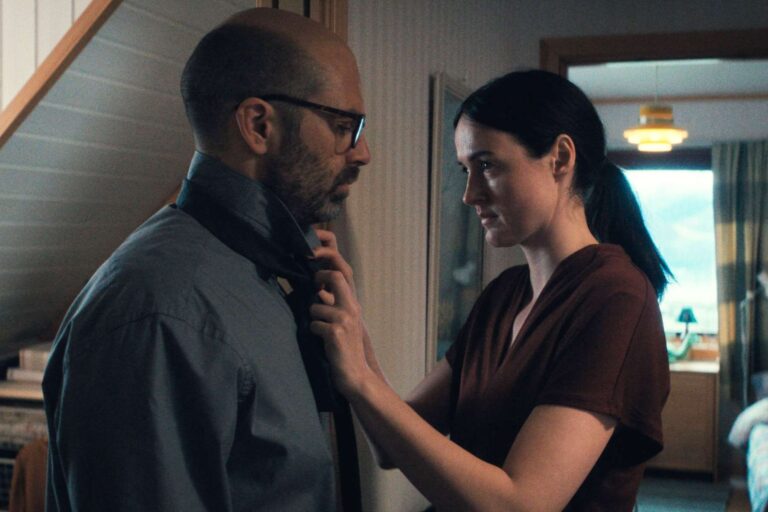
It takes a lot to incite my sympathy toward the choice of raising children under a strict religious upbringing. Cristian Mungiu’s highly schematic dramatization of a real life case in Norway pits the absurd absolute certainty of the liberal administrative state against the unknowability of the inner workings of an immigrant family. With another in an ongoing run of remarkably unglamorous performances from Sebastian Stan (reunited here with ever-stellar Renate Reinsve) and a host of cinematic flairs, naturalistic and magic, in a scenic seaside village, he almost moves the needle.
As the film opens under the crisp blue skies alongside the tranquil waters of a progressive (and strikingly beautiful) Norwegian town, Romanian engineer Mihai (Stan) and his Norwegian wife Lisbet (Reinsve) are settling their family into a new life. He’s taken on a technical job in the local government; she’s tending to their school-aged children and infant at home. The reception couldn’t be warmer, with a grateful welcome in the workplace and the schoolmaster as next door neighbor, it seems like a perfect return for Lisbet to her old homeland. The kids quickly befriend their neighbor kids, though it’s instantly clear that the Norwegian youth have far more flexibility when it comes to bending household rules or operating under strict household discipline.
Working for the first time outside of Romania and in a Western European setting, Mungiu is certainly aware of the expectations and allegiances that audiences will bring to his film. Like the liberal and inclusive people of the town, audiences (like me) might find their guard up upon realizing that Mihai and Lisbet are evangelical Christians. Further, seeing how they have employed a firm sense of discipline in imparting the certainty of beliefs into their children feels more “othering” than anything else in their immigrant experience. Their friends, coworkers, and neighbors mostly react with a bemused acceptance. At least until a minor harmless event at home triggers a spiraling firestorm of policies and procedures.
A teacher at school notices a bruise on one of the children, revealing that their family employs some form of corporal punishment. Combined with the kids sharing their strong beliefs with fellow children, the procedures of a social democracy’s child protective services spring into action, pitting personal freedoms against the good of society. Having become ingrained into the rich and complicated inner lives of the family, though, our alliances are upended. We can see how protecting children is essential, but is the swiftness and certainty of the state’s response really necessary? Doesn’t this seem like maybe a bit much? They’re such nice people after all.
In setting up this conflict, complete with invoking a slow boiling legal stand-off, that Mungiu displays a mastery of button-pushing. Sebastian Stan plays his character with the candor of his convictions that he is doing right by his family and his god. Reinsve is a quieter counterpart whose grief at being separated from her children is palpable and whose resilience is admirable. All of the kids in the movie are similarly richly drawn, we become easily invested in their coming of age journey, particularly as the pre-teens ponder the bounds of developing their own identities, challenging conventions, and breaking the rules. The neighbors serve as a counterpoint, or audience stand-in, exhibiting a sense of understanding, frustration, and desire to detach from the drama.
Although the film is based on a true case, one has the sense that it is heightened here to make audience allegiances more thorny and stretched further. Mungiu and cinematographer Tudor Vladimir Panduru capture the crisp, clean setting with its craggy titular cliffs as a mirror for the sharpness of the divide between the two perspectives. The conversations with others (or even with yourself) as the film provokes reactions are intentionally uncomfortable. Being put into that position by a filmmaker is not always the most comforting feeling, which may explain some of the muted reaction to the film following its Palme d’Or win at Cannes, a conversation pieces in fall festival queues, and a very slow theatrical roll-out. It’s not easy material, but it is assuredly executed, stuffed with big ideas and strong performances, and sprinkled with inexplicable moments of magical realism that invoke the transporting power of love. Definitely worth a watch, if only to have something to wrestle over during the holidays.
It’s a surprisingly good conversation piece with Club Kid if you’re looking for one of the season’s odder but more satisfying double features.
Fjord arrives on PVOD this week
A much shorter version of this review ran when Fjord had its North American premiere at the Telluride Film Festival; Image courtesy NEON.