



Highest 2 Lowest (2025 | USA | 134 minutes | Spike Lee)
Spike Lee’s “re-imagining” of Akira Kurosawa’s High and Low opens with Matthew Libateque’s glossy footage of New York City waking up in a golden sunrise reflected off shiny buildings. “Oh What A Beautiful Morning” from Rodgers & Hammerstein’s Oklahoma! blasts over the soundtrack as the drone camerawork circles the city’s waterfront, eventually settling in on the penthouse apartment of a new construction Dumbo glass tower. On his patio, with its prime views of the Brooklyn Bridge and perfectly framed Manhattan skyline, record executive David King (Denzel Washington) is on the phone aggressively negotiating a big financial deal.
Denzel’s David King rocks a three-piece suit, rides in a two-tone Rolls, and lives in a home full of masterpieces of African-American art (taken from Spike Lee’s personal collection). The camera lingers on these signifiers of success as lovingly as it does on the AirPods Pros and golden Beats headphones that the characters wear. The marketing department at Apple must be thrilled by their Studios partnership with A24.
It’s definitely a beautiful morning, but for him it will be anything but a beautiful day. Despite his swaggering optimism, absolutely nothing is going his way. Soon enough, he’ll break a promise to spend the day with his high-school-aged son Trey (Aubrey Joseph) at basketball camp to run an important errand with his best friend Paul Christopher (Jeffrey Wright), whose son Kyle (Elijah Wright) is his godson. After a stint doing time upstate, Christopher serves as his driver and close confidant.
Together, they arrive at the offices of King’s music company, Stackin’ Hits Records, which is about to be acquired by some soulless company. King — known for having the best ears in the business — can’t stand the thought of his life’s work of discovering and developing emerging artists being turned into AI slop (understandable!). Prepared to leverage his whole fortune to buy back controlling interest, he’s ready to gamble on what he thinks is a sure bet. His partners are less than enthused about the prospect of missing out on a huge payday and getting out of a failing industry.
By nightfall, the business intrigue will be subsumed by a call from a kidnapper demanding ransom for the return of Trey. While David’s willing to do anything for the return of his son, his feelings turn less certain about forking over 17.5 million Swiss Francs when it turns out the kidnapper napped the wrong kid: Kyle. If it feels like a big spoiler to reveal this twist, rest assured that the entire first act of the movie telegraphs the lack of drama when Trey goes missing. The most that David and his philanthropist wife Pam (Ilfenesh Hadera) can muster to their only child’s life being in jeopardy is tepid “Oh Shoot!”
It’s here that I’ll confess that I didn’t watch High and Low on HBO/Criterion ahead of this release, thinking it better to take Lee’s film on its own terms. That may have been a mistake. Thus, I can only speculate that the odd pacing, tone, and flatly mannered style of acting may be an attempt to reflect the tone of the 1963 film. Regardless of the intentions, transposed to a modern setting, the decisions prove inadvertently comical rather than reverent. The best parts are seeing how Denzel Washington, among the greatest living actors who’s screen presence is reliably legendary, reckoning with why he’s trapped in this bizarrely-paced, tonally-confusing, poorly-scripted movie and doing his damndest to break it into something worth both his and the viewer’s time. He’s never not interesting, but the inability of the rest of the film to keep up with him is a major source of incongruity that often derails the whole thing into a perplexingly failed experiment.
No matter how elegantly Lee steers the film into danger, the absurdity of its flattened tone undercuts any sense of drama. David King is a record executive of cutting-edge urban music, but the movie is trapped with Howard Drossin’s alternatively soap operatic and jazzy piano-forward orchestral score. Thus — as he’s seemingly pondering the decision of whether to save his godson’s life — we get moments like Denzel praying to the gods of music and interrogating his character’s past magazine covers that seem inadvertently comedic in comparison to Jeffrey Wright’s humble prayers toward Mecca. Ultimately, it’s social media, not morality, that steers King’s compass toward a decision.
Along the way, a trio of inept detectives (Dean Winters, LaChanze, and John Douglas Thompson) whose skills seem more fit for a CBS procedural than even Law & Order advise on the case. Their giant insight into the kidnapper’s request for Swiss Francs: 1000 is ten times larger than 100. It’s here, after conceding to a demand involving Denzel riding the 4 train with a backpack full of cash (and a gigantic GPS device), that the action finally breaks out of the stultifying penthouse that the movie gets some breaths of life.
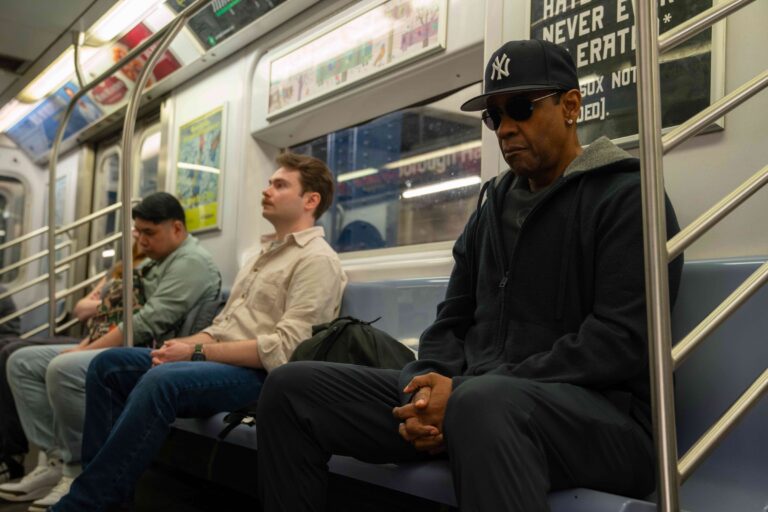
Denzel rocking a Yankee’s cap and an Air Jordan backpack on a morning subway car that fills tighter and tighter with Boston-hating Yankee fans toward the Bronx is great cinema. Impressively, based on the parade and MLB schedule, the action seemingly takes place a month after the film’s May premiere out of competition at Cannes. As the ride cuts through Manhattan, Lee intercuts the sequence with scenes from the Puerto Rico Day Parade, showing the changing face of the neighborhood where David King made a name for himself and turning the soundtrack over to a bravura performance from Eddie Palmieri and his orchestra (introduced by Anthony Ramos and Rosie Perez). The odd pacing continues through this slow-unfolding heist, but the valentine to a vibrant city is so lovingly filmed that it allows some degree of forgiveness for the ultimately dull resolution of the kidnapping plot. At times, I kept hoping that the oddness of everyone’s performances was a set-up to reveal a series of plot twists, but ultimately a scintillating story is not what this film’s about.
If you’re able to hang through the movie’s uneven opening acts — either out of dedication or unwillingness to awkwardly leave a press screening — the third act is the film’s most successful and conventionally entertaining. It’s here that we get the Full Denzel as the record executive finds his finances further squeezed and his desire for resolution frustrated by the ineptitude of the police. Denzel on a mission is reliably a good time, and this section, involving a rogue adventure through the Bronx at night, packs the most punch. It’s saved both by Denzel and by the introduction of a new character, a striving young rapper played by A$AP Rocky (also great in If I Had Legs I’d Kick You). Despite a cast that’s stacked on paper, Rocky’s the only one who brings the goods to share a stage with Denzel. Their scenes together have the electricity that you’d wished had charged the long slog of the film that preceded them.
Unfortunately, their time together onscreen isn’t enough. In scene after scene, you can feel Denzel trying to bring enough personal juice to make the enterprise worthwhile, but as great as he is and as fun as it is to see him try, it just isn’t enough. The rest of the cast is in a different movie, one in which they seemingly got their lines a minute before reading them. It’s a movie about music that has very little rhythm and that doesn’t quite know how to crescendo to a finale. Over its long running time and multiple endings — each less effective than the one that precedes it — Lee’s film makes gestures at negotiating with modernity with welcome swipes against AI and fretting over business decisions taking precedence over art. But the final images and the characters’ decisions read surprisingly treacly if not cringeworthy as a reflection on how personal choices shape one’s life, career, and the world.
I’ve liked a lot of Spike’s recent joints and reception from the screening I attended suggests that I’m an outlier among an audience who enjoyed it a lot. But just as in the music business, they can’t all be hits.
Highest 2 Lowest arrives in theaters for a limited run on August 15 and will be available on AppleTV+ on September 5.
Image courtesy A24