



One Battle After Another (2025 | USA | 162 minutes | Paul Thomas Anderson)
“Sixteen years later, the world had changed very little.” A matter-of-fact voice-over assessment cuts through Paul Thomas Anderson’s film like a sharp knife. Arriving after an exquisitely staged first act of pure adrenaline, a symphonic spree of revolutionary violence, a speed-run montage of carnal pleasures of both flesh and freedom fighting, it’s both true and not. For the characters, the earth has flipped on its axis. For the world around them, though, the struggle remains the same.
So it goes for the filmmaking, a breathless first act set in Southern California overwhelms and delights with a blink-and-you’ll-miss-it series of jailbreaks, bombings, and bank robberies all interwoven with a breakneck romance fueled by the eroticism of throwing one’s whole body into the fight to bring righteousness to a poisoned world. After all of that crumbles, the film gets going in earnest with second half that opens in domesticity. Among rural evergreens, we find ourselves in a Girl Dad stoner comedy about keeping your kid safe long after memories of the revolution have faded. That stability, too, is fleeting, giving way to another multi-threaded race toward justice. Taken together, they make for an urgently relevant whole.
For me and the legions of devotees, every Paul Thomas Anderson film is an occasion. With its rare-for-him setting in the present day and its clear-eyed confrontation of the evil idiocy that plagues our current timeline, One Battle After Another is among his most urgently relevant. Never mired in its politics or its strident willingness to take a side, it is a nonstop great time realized in full-frame VistaVision by a filmmaker who brings together an exceptionally talented cast, a warm curiosity about humanity, and daring visual panache to a script that’s continuously incisive and hilarious at every turn. It uses all the power of cinema to engage in the world that we’re living in today, clear-eyed toward its attendant horrors, while retaining the optimism to remind us why it’s still worth saving. Entertaining and strident, it’s among the year’s best: a statement piece that will stand the test of time as a document of life at the mid-point of a deeply dispiriting decade teetering on the brink.
I went into the movie knowing nothing, having stridently avoided trailers. If you want the same experience, go ahead and close this tab, grab a ticket to the largest screen you can find, and have an amazing time at the movies. For the rest, a very light discussion of plot follows.
As the film opens, we meet our revolutionaries as they prepare to liberate an immigrant detention center on the US-Mexico border. Perfida Beverly Hills (Teyana Taylor) is armed to the teeth, a ferociously composed leader of The French 75, a female-fronted group comprised largely of women of color who assert that revolutionary violence is the only way. Into their midst comes Pat Calhoun (Leonardo DiCaprio) with a wagon of explosives, ready to bring shock, awe, and distraction to their mission. For these two true believers, a lesson in wiring up a bomb is foreplay, and this first mission is the spark that ignites an intense stretch of months of fucking each other as passionately as they fuck up systems of oppression. The snap, crackle, and pop burns brightly through dozens of violent actions — including an indelible scene of a very pregnant Perfida gleefully firing automatic weapons — all the way to the movement scattering with Leo and an adorable baby in a laundry basket skipping town with an envelope full of code words and a pair of homing devices that serve as portable beacons to find other true believers with audio harmonies.
As with Newtonian laws of motion, this first raid also has an equally opposite side effect. An act of sexual humiliation against the detention camp’s superior arouses a kink that persists long enough to consult a physician for assistance. With an awkwardly disciplined ramrod gait and a silly coiffed bangs over a jarhead shave, the perfectly named Colonel Lockjaw (Sean Penn), he’s like the Terminator in an Elmer Fudd body, horny for the rascally rabbit whose politics he abhors. He’ll cause trouble long after Perfida has eluded his obsessive grasp.
While the broad outline of the plot is fairly straightforward, the nearly three-hour running time never drags. Propelled by another banger soundtrack from Jonny Greenwood and ornamented by signature needle drops too delightful to spoil, the prologue is a montage of revolutionary acts and the second finds a tenuous equilibrium upset, leading to an extended chase sequence and rescue mission. Along the way, Anderson widens his field of view to encompass layers of allies and enemies while never letting up on the pace and scale of action filmmaking. Thomas Pynchon gets a “based on” credit for Anderson’s script taking inspiration from Vineland. I confess that a used copy of the novel has been sitting on my shelf unread for decades, but the Wikipedia synopsis suggests that Anderson’s take on the 1980s-set novel is more of its themes of revolutionary fallout, long-estranged mothers, and personal obsessions than a direct liftover. It definitely shares the Pynchonian bent for comedy, circles within circles, secret societies, and vast evils perpetrated by petty idiots. It’s a milieu of dangerous and conflicting agendas, misuse of structures of power and present paranoias, serious consequences and silly rituals, constantly tested allegiances, and believers finding (or resisting) their breaking points.
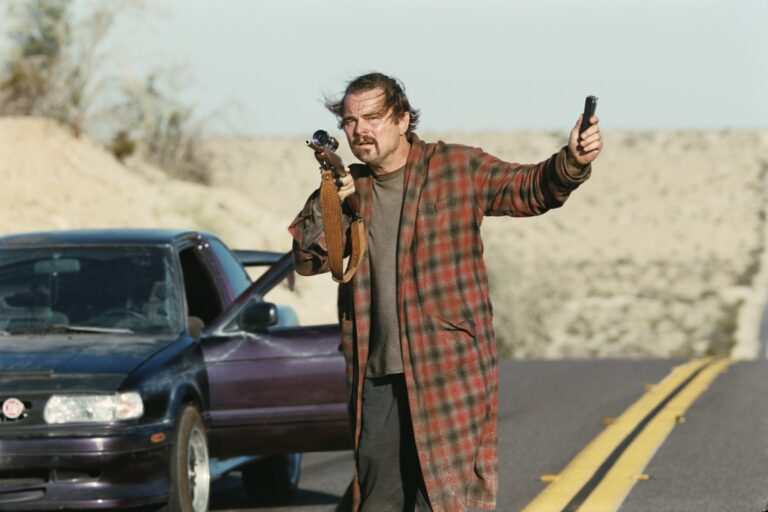
Across the board, the cast turns in top-tier work. As Perfida Beverly Hills, Teyana Taylor defines the first act with single-minded devotion to revolution, an unabashed champion of torching oppressive power structures to the ground while having an absolute blast doing it. Her character’s a runner and the new guy’s a stump. So when she makes an exit halfway through, the movie’s left in the capable hands of Leonardo DiCaprio who’s more than willing to embrace the foibles of a stoned, drunk, aging Girl Dad whose mind and body have softened after years in hiding. Long after putting away his bombs, he spends his days in a flannel robe and overgrown hair, drinking and hotboxing his way through hungover afternoons. While he still believes in the cause, he’s more moved by paternal devotion and the relief of hearing that his daughter’s doing great at school. It’s a deeply felt yet comedic performance of a paranoid dad out of his depth whose energies and anxieties are focused entirely on preserving his kid’s safety. That daughter, seemingly untethered from direct activism and growing into the more responsible party in the single parent household, is ably played by Chase Infiniti in her feature film debut, holding her own in an often reactive part alongside some titans of cinema. When she finds herself in peril, we easily have confidence in her abilities and instantly believe in DiCaprio’s performance as a father’s determination to save her no matter how many obstacles (many of his own making) stand in his way.
The rest of the cast is populated with memorable performances by Benicio del Toro as a sensei and Regina Hall who makes a late impression as a long-serving revolutionary survivor. When these other characters appear, the seriousness of the moment snaps into focus. Chief among them, though is Sean Penn in a fearlessly goofy performance. It’s been a while since Sean Penn’s had a role this freeing and funny, as Lockjaw he’s a pathetic menace, a dangerous lumbering punchline, and a potent counterbalance.
I hate to make movies fight, but couldn’t avoid thinking about how differently One Battle After Another treads in the same present-day toxic waters as Eddington, this year’s other auteur-driven statement on How We Live Now. This is a case where choosing my fighter is easy. Where Ari Aster’s modern Western was infected with cynicism toward the entire spectrum, seeing the whole thing as a futile horror, Paul Thomas Anderson has no trouble choosing a side and holding onto a belief that humanity is worth the struggle. Whereas Aster’s most pointed jokes were about a white guy who parrots woke politics to get laid, Anderson’s white guys find their lives transformed by working alongside badass women who are transforming the world one altercation at a time. Immigrant detention centers are abominations to be violently disrupted, their captors deserving of shame. The cabal of white supremacists pulling strings against “sanctuary cities” and toward racial purity are depicted as country club idiots with inflated egos and embarrassing rituals. They’re a sad contrast with the vital communities of color who form networks of mutual support whose actions, be it gunplay, fireworks, or parcour skateboarders cutting across rooftops of a city in flames, always look awesome through the lenses of cinematographer Michael Bauman.
With its paramount concerns in immigrant rights and bodily autonomy situating it in squarely among modern day struggles, these essential concerns never bog down Anderson’s commitment to making a relentless entertainment. With deep empathy for the human hearts that find connection in fighting back against a world in decline, Anderson’s film is charged with comedy and nonstop action that hurtles toward a conclusion that phenomenally satisfies on multiple fronts. When the well-earned payoffs arrive, it’s enough to make even the most skeptical amongst us believe that the revolution stands a chance.
One Battle After Another arrives in theaters on September 26th
Lead image courtesy of Warner Bros.