

Backrooms (2026 | USA | 100 minutes | Kane Parsons)
Liminal horror, to be certain, is enjoying a moment.
The last six or seven years have seen an influx of liminal horror movies hit theaters and streaming, exploiting the dread inherent in an empty space that turns out to be larger, darker, and more incomprehensible than first meets the eye.
Elements of liminal horror have frequently surfaced in horror and fantasy cinema over the decades, but the current iteration represents a distinctively 21st century sub-genre, one descended directly from Creepypasta and other online content.
Most liminal horror films deliberately, often proudly, avoid traditional three-act structure, frequently delivering corridors to nowhere, abandoned buildings rife with foreboding shadows, physics-defying settings that’d give M.C. Escher a massive aneurysm, and ambiguous endings that generate more questions than answers. And with most of the sub-genre’s purveyors skewing young millennial and Gen-Z, liminal horror taps into the queasy disorientation inflicted on those demographics by the economic, societal, and environmental disintegration of the world around them. They’re less a scream-filled roller coaster ride, and more a slow, creepy, inexorable walk into the unknown.
The very fluid, decidedly internal nature of the sub-genre breeds wild inconsistency, with a fair amount of its entries generating more frustration than fear (one of many examples of the former, Undertone, released theatrically last March). Fortunately Backrooms, director Kane Parsons’ cinematic mutation of his popular liminal horror video series, represents one of the stronger movies to ride the crest of this cinematic wave.
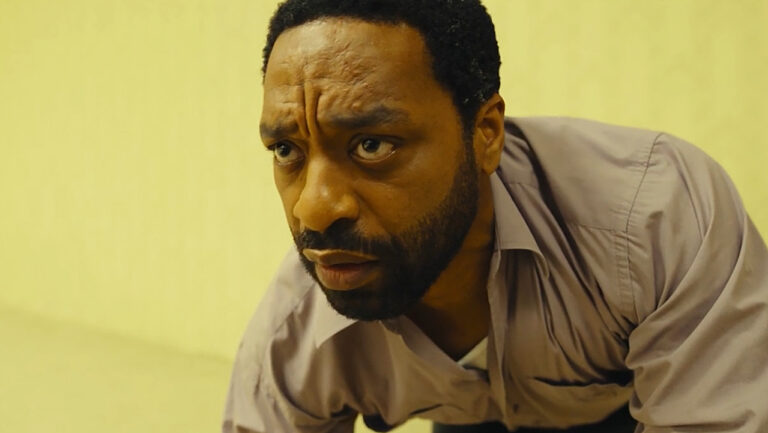
Down-on-his-luck divorcee Clark (Chiwetel Ejiofor) owns and operates a struggling furniture store, spending his off-time largely drinking, wallowing in self-pity, and attempting to tame his deep-set anger via therapy sessions with his placidly patient shrink, Mary (Renate Reinsve). He’s living at such a low ebb that he sleeps in a display bed in the back of his store.
One night, he’s awakened by a light emanating from an apparent seam in the wall of the showroom. He tries to pinpoint the source, and his exploration leads him to discover a portal into a large, labyrinthian network of backrooms cluttered with otherworldly detritus, swathed in deep shadows, and alive with strange growls and noises emanating from the space’s many dark corners.
Clark soon recruits his two employees, Kat (Lukita Maxwell) and Bobby (Finn Bennett), to help him record and retrieve evidence of the backrooms’ existence. And eventually his therapist Mary’s drawn in. All the while, the space appears to be warping its occupants’ dreams and fears into something very tangible, and very, very threatening.
Then again, maybe it’s not. If you’re looking for a straightforward horror movie that follows standard tropes and neatly wraps itself up in a bow by the finale, look elsewhere. Once Backrooms establishes its characters and central conceit, it dives headfirst into an orgy of bizarre imagery, spasms of violence, and languid headiness with fever-dream fervor. And like most liminal horror, it’s much more of a haunting, haunted Rorschach test for a viewer than an assembly-line thrill ride.
How this goes down for the average viewer may vary. The sometimes patchy script by Parsons and Will Soodik sketches its characters adequately, but offers little by way of explanation, ground rules, or formula three-act momentum, and that’s bound to frustrate some.
Thankfully, Backrooms weaves a spell distinctive and arresting enough to ride out the rough spots. Parsons boasts some impressive skill in the director’s chair, successfully expanding the confining aesthetic of the original series into an immersive, genuinely chilling experience worth catching in a theater. He gets optimal mileage out of implying as much as he shows: the actual monster/s largely dwell in the shadows, just out of view, until things get nicely batshit near the end.
And while the script falls short on its characterizations, the work of the principals fills in the gaps surprisingly well. Clark is one messed-up piece of work, and Ejiofor gets inside the character’s barely contained aggression and despondence without alienating audience sympathy. Ejiofor’s performance, more than anything on the screenplay page, makes the places that Clark goes to (metaphorically and literally), all the more harrowing. The gradual assault on Mary’s unflappable, quiet exterior quickly escalates towards the end as the horrors of the backrooms reach their peak, and Reinsve’s acting captures Mary’s mounting fear and panic with far more depth than what’s in the script.
Backrooms’ last few minutes recall H.P. Lovecraft, David Lynch, and Creepypasta all at once, with a strain of ironic humor punctuating the closing reel. And if its final shot fails to offer any resolution, Backrooms still packs a punch. You don’t have to understand an image on a Rorschach test to be deeply, wonderfully unnerved by it.
Backrooms opens in theaters nationwide today, Friday May 29. Image courtesy A24.