


La Bola Negra
(2026 | Spain | 159 minutes | Javier Calvo & Javier Ambrossi)
[Editor’s Note: Fittingly for a sprawling multifaceted historical re-imagining, La Bola Negra is sparking conversation. Josh had a mixed-admiring reaction out of its Telluride North American Premiere. Ahead of this week’s theatrical release, Morgen and Eric came out of a local FYC screening with very different responses, read ’em all and decide for yourself!]
A traipse through a century of Spanish history as seen through a few gay icons, La Bola Negra is a very fashionable film, at once a conscious entry in contemporary cinema’s ongoing fixation with the archive and a throwback to Miramax Oscar Bait, characterized not inaccurately as The Hours for Federico Garcia Lorca. It’s also fashionable then, that it’s totally juvenile, a lumbering piece of fanfic which signifies tantalizing pleasures – gay erotics, Hollywood epics, transcendent love, historical excavation, but lands squarely within the realm of middling BL.
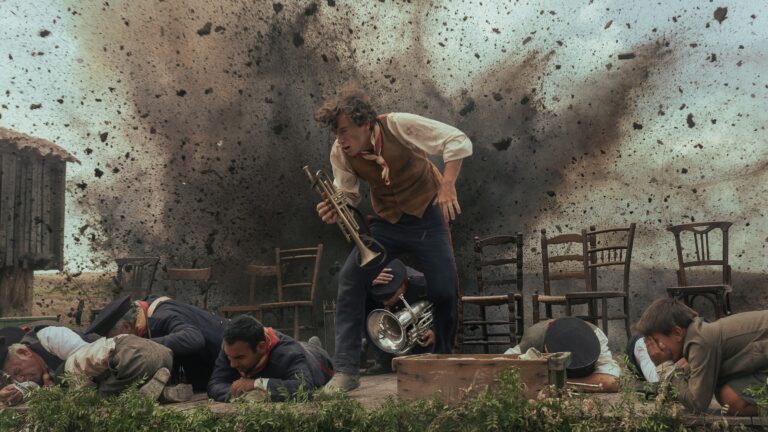
The film opens with two instances of pinkwashing. The first is literal, as archival photographs are smeared with pink paint during the opening credits. In the second, Sebastian (Guitarricadelafuente) is playing his trumpet in 1937 when Franco’s forces invade his village. Cornered in the woods, they shove a gun into his hands, a gesture that establishes him as a “good fascist” when he eventually enlists.
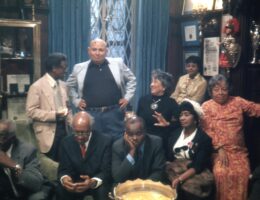
La Bola Negra will cut between Sebastian’s story and two others: one set in 1932, where a young Carlos (Milo Quifes) is denied initiation into a casino social club because of his homosexuality, and the other in 2017, where Alberto (Carlos González) , a bespectacled historian receives a lost Lorca manuscript, La Bola Negra, as an inheritance from a grandfather he never met.
The way these storylines converge is quickly revealed, and what’s most damning about each of La Bola Negra’s three narratives is how utterly generic they are, reconfigurations of recognizable contemporary tropes somehow meant to be less regressive or lazy because Netflix has pumped its entire Awards Season marketing budget into this relic from the “we’re here and we’re queer” corporate pride heyday of 2017. The tragic enemies-to-lovers trajectory of Sebastian’s storyline is pre-ordained the moment he gazes upon the hunky chest of Rafael (Miguel Bernardeau), a Loyalist prisoner of war, as is the tragedy of the 1932 storyline, which hinges on whether Carlos will be loud and proud amidst a stock cast of overbearing fathers and faceless homophobic socialites.
The inevitability of the tragedies is totally fine (Paper Tiger is one of my films of the year), but Los Javis’ (directors Javier Calvo & Javier Abrossi) forceful, haphazard attempts at making them operatic runs headfirst into their sheer lack of imagination. La Bola Negra is entirely expository, with seemingly no interest in these characters or their setting beyond going through the motions of the cheapest gay stereotypes. They could be switched for any time period or any political conflict and little would change. The 2017 timeline is more of a facsimile of Rouge or Longing, where the lack of glamour stands in stark contrast to the classical beauty of the past. That this point is made through Alberto’s overweight, dorky appearance and a hacky deployment of the Grindr sound effect would also be less unfortunate if it weren’t the primary way it were making this distinction. Aside from his relationship with his mother, everything else in 2017, from the specifics of Alberto’s research, to his former career as a playwright, his open relationship with Julio Torres, his hookup habits, his queer friends, is so indifferently sketched as to be runtime fodder, just sitting there to provide a semblance of a milieu.
What La Bola Negra is is a fetish object, and a shockingly tasteless one at that. The characters in the 1932 and 1937 narrative strands exist first as objects for sexual consumption, humans, well, never. La Bola Negra is a film with the gall to eroticize the victims of fascism as their bloody, naked figures are splayed in the back of a truck and dragged off in a tastefully choreographed long take. When Rafael is beat up by the Hot Fascists, Los Javis use his pain as an excuse to tilt the camera down and tease us with his dick.
Part of what they’re aiming for here is making the subtext of their myriad influences the text itself. The Hot Fascists do their training exercises naked, but Sean Cody’s Beau Travail isn’t nearly as erotic as Claire Denis’s Beau Travail. When Penelope Cruz shows up to give a pair of Cabaret performances, its power is diminished by how conscious her role is as Diva Worship incarnate. Even the play on The Hours is making the film’s rabid gay fanbase the subject of the film. As a hodgepodge of references, La Bola Negra often recalls better films, the 1932 segment aping both the sweeping camera movements of Jancso’s war films or Saura’s adaptation of Lorca’s Blood Wedding, the 1937 segment a xerox of the aesthetics of The English Patient, its interface with the future a sorry shadow of Benediction or The Secret Agent. The film moves between the segments in such a way that prevents any coherent rhythm within or between shots, and the result is a garish proclamation of taste, one that reveals this supposed monument to gay history as a solipsistic monument to gay cinephilia, using history and cinema as a playground, stopping short of actually concerning itself with queer aesthetics. If you squint hard enough, the Spanish Civil War looks sort of like Mother Lake.
The result is both too much and not enough. There’s a better version of La Bola Negra that would embrace its vulgarity like a John Waters film, with more sex, more nudity, more flamboyance. And yet, for all of the erotics on display, La Bola Negra is mostly chaste. When Hot Italian Fascist decides to free Rafael on his last night on earth for some reason, what was presumably a night of passionate sex between him and Sebastian is reduced to the pair simply touching foreheads, whisking us into flashback where Lorca says he hopes this story will help younger generations of “the ones who put beauty marks on their faces”. Los Javis make sure to separate Cruz’s performances with a speech about transness being the opposite of war just to make sure we know this is actually a Serious Movie about existence as resistance, despite the fact that our protagonist is supposedly killing on behalf of an impending fascist regime. La Bola Negra is so convinced that it’s some substantial historical intervention to the point where they cast Glenn Close (one of many women who exist solely to deliver platitudes about suffering at the hands of the patriarchy or explain the film’s themes) as an American Lorca scholar to discuss the importance of history, how what interests her about it is the characters and the context that informs their actions.
What do the Hot Fascists, in the middle of an ongoing war, do all day besides serve cunt? What do the young gays in 1932 do besides serve cunt, in beautiful suits? Los Javis have no feel for any interpersonal relationship, whether that be Sebastian’s relationship with the other soldiers (in part to avoid grappling with his complicity in fascism), what the casino represents in 1932, what anyone in that timeline might do in their daily lives, let alone the relationships between Carlos’s two indistinguishable gay friends or the nondescript groups of homophobes he encounters.
There’s something theoretically interesting in La Bola Negra’s fetishism adhering to the aesthetics of fascism. Perhaps Los Javis mean to equate our contemporary inclination to treat the past like a Tumblr page for our sexual fantasies with Sebastian’s fascist gaze, but this is entirely unexamined. It feels incredibly calculated that Los Javis avoid showing us the brutality of war, reducing it to frolicking men lounging in picturesque landscapes who occasionally shout the f-slur, because if we saw how Sebastian might treat a prisoner he’s not sexually attracted to, or out on the front mowing down the Loyalists, we might look at his budding attraction with cocked brow. Penelope Cruz’s “love is love” speechifying about queerness transcending political difference is hard to take because Los Javis are so intent on making sure we know that Sebastian is actually apolitical, just there to go with the flow, as opposed to everyone else. In fact, it’s actually great that Sebastian fought for the fascists, because if he weren’t there, no one would have been able to recover Lorca’s lost manuscript. La Bola Negra’s insistence on triumph, even as its tragedies collapse upon each other, is the epitome of its aesthetic cudgel. Sure these people suffered, but they served, so it was necessary!
La Bola Negra arrives in local theaters on Thursday November 5; it will be available for streaming on Netflix on December 2nd.
Lead image courtesy Netflix.