


After the Hunt (2025 | USA | 128 Minutes | Luca Guadagnino)
It’s hard to know what to make of Luca Guadagnino’s new film, a puzzling muddle of a campus #MeToo drama. If we are to take the press notes at face value, it aims for “Twisty Psychological Thriller”, but if I were the teaching assistant responsible for grading the assignment, I might mark it up with red ink asking whether it was partially intended as parody or clumsy provocation.
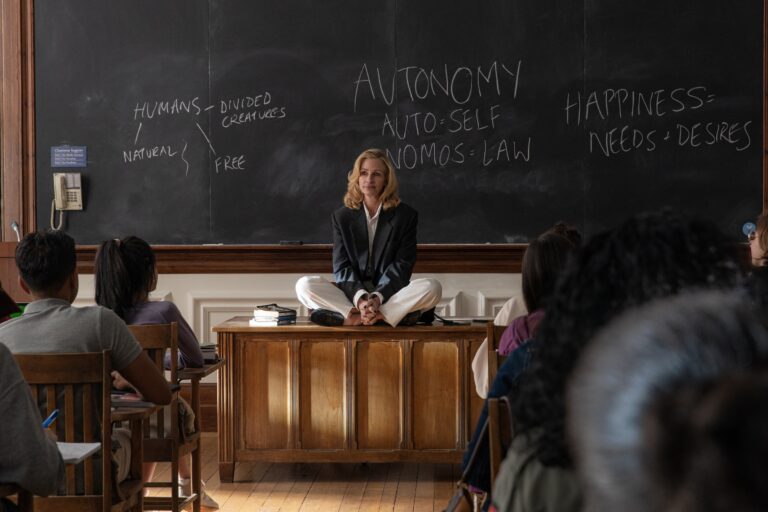
I’ve often thought that the unifying thread through the Guadagnino-verse is people being driven mad by passions. In this case, that longing isn’t human flesh, ripe peaches, or the affection of a tennis coach, but instead the even more elusive golden ring of tenure at an Ivy League university’s philosophy department. Set against a ticking clock, the opening titles glare: “It happened at Yale” in a typeface oddly reminiscent of Woody Allen’s favorite, which can’t have been a mistake. As the story opens, we follow, tick-tock, tick-tock, a day in the busy life of professor Alma Imhoff (Julia Roberts, ever-luminous) that concludes with a departmental dinner party at the home she shares with her psychotherapist husband (Michael Stuhlbarg). She’s wearing the perfectly tailored white suit that was laid out for her that morning, the jacket cut so impeccably that she manages the whole party seemingly without a single layer underneath; he’s dressed in a silly little tuxedo, white shirt buttoned to his neck with no tie. This level of style among academics situates the action in at least some realm of fantasy (London doubles for the fictionalized New Haven.)
Among the guests tossing conversational fireballs over hors d’oeuvres are Alma’s fellow associate professor Hank Gibson (Andrew Garfield, in rare louche mode) in the hip professional uniform of jeans, blazer, and barely buttoned shirt, and her star doctoral student Maggie Resnick (Ayo Edebiri), dressed in a black suit to darkly mirror her mentor. Their collective familiarity with each other, including but not limited to their inner thighs as points of emphasis, is the first among many unsubtle signposts for troubles ahead.
Working from a script by first-time screenwriter Nora Garrett (herself a Tisch graduate), Guadagnino wades quickly into the clichés of modern academia and the provocations of imbalanced power structures. After amicably leaving the party together, Maggie shows up the next evening soaking wet to disclose to Alma that after walking her home and coming upstairs for a nightcap, Hank “crossed the line”. When asked exactly what she means by this, she takes offense at her mentor’s cool response and implied defense of her old friend and colleague, pointedly refusing to say more. This ambiguity of the storytelling decision may have been intended to challenge the audience’s dispositions on who to believe, but as the film goes on, it rings more like an intergenerational sneer, a studied coyness, or a shallow goading toward the unknowability of truth. [For infinitely better handling of these issues, please see this year’s Sorry, Baby]
Soon the scandal ripples across campus, with Roberts left playing Alma as increasingly calculating as she vacillates between her friend and mentee, weighing the implications of her alliances on her career. Each episode and reaction becomes more highly pitched, overreaching in complicating the story and broadening its targets while remaining steadfast in preserving some element of vagary. It’s barely mentioned that Julia Roberts and Andrew Garfield are more than a decade apart in age, yet vying for the same academic promotion, but that too may be a sly jab at differential privileges. Like a student overeager for praise, it double-underlines its references, highlights its themes, and applies bold type to make sure that the reader appreciates the work. As just one example, all Maggie will reveal about her oddly mysterious thesis is that it’s about the “resurgence of virtue ethics”; leading one to wonder whether the director intends her character as a cautionary tale or acting out a performance piece, maybe both. Themes of wealth and privilege bounce against academic narcissism and plagiarism. Marital strife, infidelities, and cancel culture marinate alongside hints at deeply held secrets and mysterious illnesses.
Somehow, against all odds, the talent of the actors makes much of this highly watchable, even as the tone becomes more bewilderingly overcooked and the characters’ motivations less relatable. Seemingly bored of playing the perfect husband, Stuhlbarg’a typically doting understanding spouse momentarily slips into A reenaction of the venal husband from Anatomy of a Fall, blasting music over a quiet dinner conversation between his wife and her traumatized student, who he antagonizes for no reason. A campus therapist played by Chloë Sevigny freely betrays confidences over wine at the campus dive bar, musing in surprise that the Smiths are still on the jukebox after Morrissey’s cancellation. (That someone else makes the distinction that it’s OK because it’s a Smiths song is indicative of the slyness of the film’s discourse.) As the movie swings into a lesser, worse-executed version of Todd Field’s masterful TÁR (complete with a public dressing-down of a “woke” student, the ticking clock, the perfect suits, and a hideaway working apartment), one again can’t help wonder if borderline parodic remix is the intent.
Further complicating my response to the film’s flawed storytelling is its presentation. It is, from start to finish, filmed with such exceptional beauty that I never really minded being dragged along through its intentional contradictions and structural artifice. The very busy Trent Reznor and Atticus Ross’s piano-forward score pokes at the Ivory Tower, prodding the characters and their foibles ahead. Julia Roberts never drowns in this slippery material and remains a marvel to watch onscreen. Most impressive is how Cinematographer Malik Hassan Sayeed films the academic environment, actors hands and faces, and their surroundings with such softness and care that it’s still a pleasure to be wrapped in the story even when it stumbles. The phenomenal wardrobes put together by Giulia Piersanti are depicted as if each frame is a fashion shoot while still allowing the actors to look like real people comfortable in their muted yet impeccable clothes. Even the hall-of-mirrors campus tandoori diner looks as entrancing as anything from I Am Love: spicy chicken wings have never looked better than when Andrew Garfield’s eating them while spiraling to justify his bad behavior. Such are the contradictions of this movie; it kind of demands seeing to be believed, but even then it leaves the viewer in a fog of being mostly annoyed but a little bit impressed. Good enough to skate by with a freshman term project, definitely not strong enough for promotion.
After the Hunt arrives at SIFF on October 15 with wider release on October 17
Image courtesy of Amazon MGM Studios