


Mother Mary (2026 | USA | 112 minutes | David Lowery)
David Lowery might become best known for having directed Robert Redford’s last starring performance (the incredibly charming true crime drama The Old Man and the Gun) and making perhaps the only good live-action adaptation of a beloved animated film (the near-perfect Pete’s Dragon). His exceptionally successful filmography has also included grounded doomed love stories (Ain’t Them Bodies Saints) as well as fantastical investigations of the grave prices required to counterbalance the cosmic weight of fleeting success (The Green Knight) and spare explorations of inextricable bonds that stretch across time (A Ghost Story). His new film, Mother Mary, shares with those films an openness to the surreal as well as the ability to give main character energy to bolts of fabric. Bolstered by two entrancing performances from Anne Hathaway and Michaela Coel, it joins his other films as deeply fascinating and surprisingly revelatory examinations of humanity.
The film opens on two women, physically and professionally separated yet still deeply entwined. Although the lens is on global pop star Mother Mary (Anne Hathaway), it’s the seething and embittered voice of Sam Anselm (Michaela Coel) that we first hear. Like a cancerous lesion or rising bile in her stomach, she can sense the inevitable approach of her onetime friend and creative partner. When Mother Mary has a headache at a costume fitting for her latest tour that’s going badly, Sam Anselem pops an aspirin in her mouth thousands of miles away.
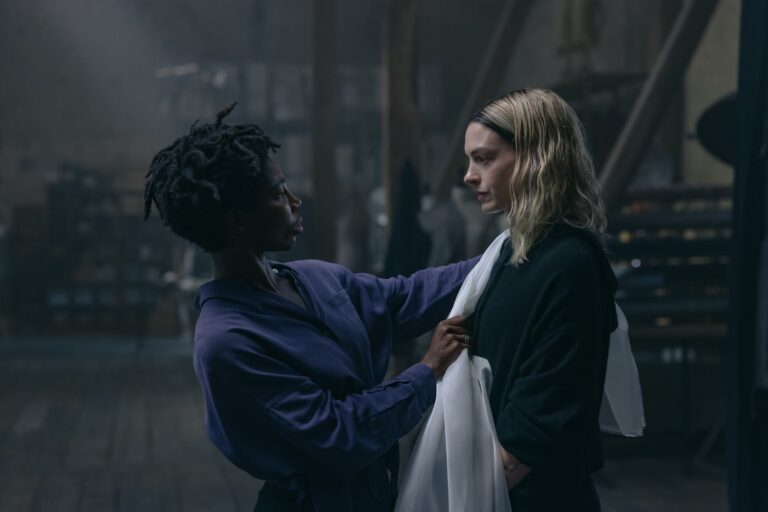
Soon enough, Mary’s private jet brings her – de-glammed, fried blonde highlights, and rain-drenched baggy athleisure — to Sam’s countryside atelier. Barging in unannounced, she’s an unwelcome interruption for a fashion designer on a deadline. Although they coolly offer her tea and snacks, neither Sam nor her assistant (Hunter Schafer) are amused. She’s written the best song of all time, but the dress that she’s meant to wear to re-launch her music career (in a matter of days) after a calamitous break from the spotlight is “all wrong” and she doesn’t trust anyone other than Sam to help her. We know how Sam feels about Mary, but even if the appeal of minting the image for a comeback isn’t enticing enough, there’s something irresistible about the possibility of picking at the long festering wound from a newfound position of power.
With that, the duo retreat to a spacious barn across the property. It’s full of mannequins, all sorts of fabric, desks for sketching, a platform for taking measurements, and plenty of space to be filled with accusations and apologies. Lowery uses the cavernous space, be it lit by the fading gray daylight or more candles than one would think appropriate for a room full of fabric, to maximum theatrical effect as a memory palace.
As Mary and Sam interrogate their personal histories, Coel and Hathaway perform an entrancing two-hander. It’s impossible to take your eyes off them as they peel through layers of pain and anger. We learn that Sam was responsible for crafting the imagery for Mother Mary early in her career, the two women’s careers intertwined on a rocketship of fame, until an unceremonious break left her reeling. With her striking angular features filmed in close detail, Coel is the initial antagonist, her character having built up walls of protection after flipping a switch that isn’t easily moved by her onetime collaborator’s non-specific apologies. It’s a rare shift in the power dynamic to find herself now in a position of control, but she relishes the opportunity even if it hurts to see her onetime friend again. With remarkable vulnerability, Hathaway captures Mary at a point of desperation, the mask of fame having slipped, leaving her softened sadness exposed. Whether their partnership extended beyond creative collaboration to anything romantic or sexual is left unspecified, but a broken friendship and betrayed partnership can cut just as, if not more deeply than any relationship break-up.
Both performances are exceptional, both in their physicality and emotional intensity. At one point, Hathaway performs a stunning and taxing modern choreography sequence in complete silence (Sam refuses to hear Mary’s music, including the new song which is aptly titled “Spooky Action”), scored only to the rhythm of her body moving across the barn’s wooden floors and the sounds of her breath as she exerts herself to a dance she’s committed perfectly to memory. It’s astonishing and alien, a feat of physicality that introduces the possibilities of the supernatural transformative potency of art.
Despite taking place in one location, it’s hardly a chamber piece. In flashbacks and cutaways, the production blooms into a grander scale as as we witness iterations of Mother Mary’s stadium-scale career at pivotal moments. It’s a perfect contrast that makes use of Hathaway’s natural “theater kid” perfectionism, which we see as she evokes hints of the pop icons of recent generations. The stage name “Mother Mary” clearly evokes Lady Gaga, but iterations of her look – marked by an evolving halo as a signature costume element – sound, and stage presence is far more piously witchy than Gaga’s oeuvre and whose fans are more plainly adoring than throngs of Little Monsters. Lowery mentions taking inspiration from all the greats (Gaga, Madonna, Taylor, Beyoncé), but his conception of the character, with costume designs by Bina Daigeler (evoking McQueen sensibilities) and original songs from Charli xcx (who explored similar territory in her own The Moment), producer Jack Antonoff, and multi-hyphenate FKA Twigs (who herself appears to pivotal effect in this film), results in something original enough to avoid any direct impersonations.
For quite some time, Coel’s Sam is driving the show, setting the pace and terms of their rapprochement. As she begins sketching out ideas for this dress, she pokes and slices at Mary and their past. It’s a fascinating bit of timing that Mother Mary and The Christophers were released within weeks of each other. They’re fundamentally different, yet successful performances, both of which find Coel in the position of scrutinizing the history of another artist. Here, she conveys a self-protective dominance and unpredictability in the face of this reunion, having long since sublimated her pain into a renewed power.
It’s an attitude and insistence that eventually propels the two women headlong into the realm of the supernatural. As the night goes on, cinematographer Andrew Droz Palermo films both of them sparring in shadow with candlelight (or spotlights) reflecting eerily in their dark eyes, like dark, almost alien orbs. Stories unfold in surreal and sometimes detailed, slipping both from and into the studio like a kind of dream theater of past transgressions. Importantly, having previously made a film that used Casey Affleck covered with a gigantic bedsheet to remarkable effect for its entire running time, Lowery is no stranger to the emotional possibilities of fabric, but here (working again with A Ghost Story’s Annell Brodeur, along with artist Daniel Wurtzel and dancer Taylor Sieve) he has created something ravishingly evocative with a diaphanous and metamorphic undulating yards of silky crimson fabric. In giving physical shape to the ghostly force that has kept them entangled even in their many years apart, he builds to a gory and cathartic climax that commands rapt attention as the film dances at the edge of horror and fantasy. The alchemy of Hathaway and Coel’s raw performances and Lowery’s comfortably inhibit the tenuous territory between reality and fantasy, combining to conjure a mesmerizing, multi-faceted portrait of a pop star whose world tour is more worth the price of admission.
Mother Mary arrives in local theaters on April 23
Images via A24