

Paper Tiger
(2026 | USA | 114 minutes | James Gray)
With Paper Tiger, the latest family drama from James Gray — like its spiritual predecessor Armageddon Time — we are again transported back to Queens in the 1980s in New York City. Whereas that coming of age story reflected on teens getting into trouble while cutting class, stumbling into the privileges of race and the responsibilities of family legacy, the stakes here are considerably higher and the undercurrents even darker.
As the film opens, it’s a lazy weekend for everyone except Irwin Pearl (Miles Teller), a neighborhood dad with early morning enthusiasm for his long list of home improvement chores. An upbeat engineer, he’s raised his Jewish family in Queens, achieving a sense of financial comfort if not outright success. They’re happy in the neighborhood, resisting in-laws nagging calls to finally move to the suburbs where comforts of the club and swimming pools beckon. He has a good natured relationship with his teen boys, but with them on the precipice of graduation, though, it’s clear that the middle class comforts they enjoy are about to be stretched as college tuitions loom.
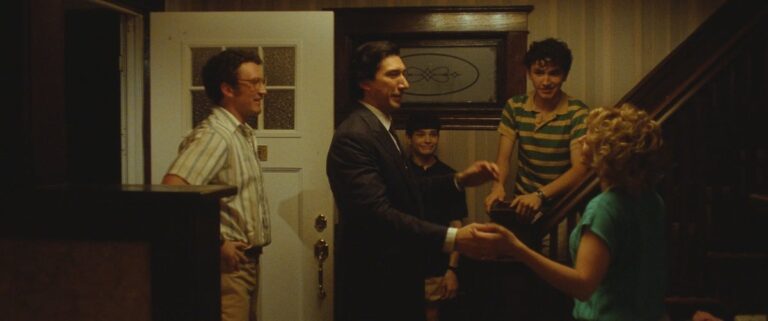
A surprise visit from his older brother Gary (Adam Driver, instantly the coolest uncle), brings both a flashy steak dinner catered by Peter Lugar and an opportunity to enrich his family finances. As portrayed by Driver in an 80s Italian power suit, a shiny Mercedes in the driveway, a service weapon still strapped around his ankle, Gary’s instantly reads as the cool soon-to-be-single-again uncle. A cop who worked his way up the hierarchy to a position of influence and prestige, he’s already retired from the force and entered a private sector where the connections he developed there have already proven lucrative.
After a raucous dinner, the brothers slip away to the basement to talk privately. It’s there in a dusty workroom, that world-wise older brother woos his steady-as-he-goes civil engineer younger brother to consider teaming up and reaching beyond his square workaday existence for a shiny brass ring in the form of tax-free consulting dollars. The proposition is coming at exactly the right time, but it’s one that will draw Gary and his teen boys into the literal and metaphorical stink of the Gowanus Canal on the verge of profitable rejuvenation from superfund site to desirable neighborhood. A mix of naïvety and hubris, though, will set into motion a dangerous chain of events that will shake the family to its core.
Gray’s textural depiction of the time period and a city ever on the brink of transformation has countless pleasures. Most surprisingly among them, perhaps, is the degree to which Miles Teller has slid into “square dad” territory as the bespectacled do-gooder patriarch of the family. Driver is predictably terrific, bringing an edge of sadness to a man whose charmed existence doesn’t extend to his personal life and whose ability to exist above the fray is running up against its limits. As the brothers dig themselves deeper into the menacing muck of the wrong side of the Russian Mafia, Scarlett Johansson mostly triumphs over a capricious wig as a mother who’s quietly bearing the weight of her own looming tragedy. Rounding out the family are two strong performances from young actors Gavin Goudey and Roman Engel, as the teens whose eyes are being opened too soon to the perils on the rough edges of the big city.
As shot by Joaquín Baca-Asay in nostalgic hues and gritty film stock, the look of the film is incredible. It conveys a classically gritty feeling, especially as we experience contrast his quiet comforts of Queens with the shadowy elements of the inner boroughs. The Brooklyn of this time period, after all, isn’t buzzing with hipster cafes or high-end game shops whose priceless animatronic birds start social media firestorms. The water in the canal isn’t hardly the only thing that’s toxic down there, and Irwin’s ill-advised decision to take the kids down to a worksite one night to prove his bona fides results in the clueless dad stumbling into seeing something he shouldn’t and the kids experiencing a terror that they’ll never forget.
The depiction of the deepening chasm that results is one of supreme control and mounting dread. The action alternates between Irwin’s attempts to blunt the seriousness of the incursions into his homelife, while Gary attempts to undo the damage and suspicion that his brother induced. The intersection of family and criminal drama are paired in extremely compelling fashion, textured with mid-1980s vibes, masterfully composed sequence after sequence set the family (and audience alike) on edge with unsettling mob menace. All the while, ever-present malaise and uncertainty hangs over the loving family as they trip into dangerous waters. Navigating fraternal desperation and sacrifices with supreme control, Gray takes the film out on a series of extraordinary sequences, with a tremendously tense climax concluding on the outskirts of the city whose growth has motivated the action. Set among the tall grasses with the iconic skyline dwarfed on the horizon, this sequence, like the film itself, this sequence ranks among the year’s finest.
Paper Tiger has a limited theatrical release this weekend, with more to follow. Ahead of wider Seattle release, SIFF will be showing a 35mm print at the Uptown on Monday November 16 and Tuesday November 17th.
An earlier version of this review ran as part of our coverage of the Orcas Island Film Festival, where Paper Tiger had its regional premiere. Image courtesy NEON.