

I Play Rocky (2026 | USA | 128 minutes | Peter Farrelly)
A week or two ago, I was watching Jeopardy!, as I’m wont to do, when this question came up as a Daily Double: “Among the fight fans watching underdog Chuck Wepner battle Muhammad Ali in 1975 was this actor who went home & wrote a script.” I immediately knew the correct answer was “Who is Sylvester Stallone?” The contestant went all-in and missed. I’m certain having the preview screening of the upcoming I Play Rocky on my calendar helped with the instant recall so I didn’t need to first mentally rule out Raging Bull and Every Which Way But Loose.
But something else happened in that moment: my outlook on the movie changed, like a light switch had been flipped. I went from curiously bearish to genuinely enthusiastic. The Jeopardy! question reminded me that Rocky is likely the greatest sports film ever made. It was the highest grossing movie of 1976 and won Best Picture, so it certainly earned its place as one of the most beloved. It’s the quintessential underdog story, both on screen and off, thanks to Stallone’s insistence that he star in the movie or it not get made at all. I realized in that moment that I was going to afford a movie like I Play Rocky a degree of goodwill by default. Unless that goodwill gets squandered in some egregious fashion, like changing Rocky Balboa’s sport from boxing to competitive baking, I’m probably going to enjoy this movie.
Truth be told, I Play Rocky is awesome.
I Play Rocky is awesome because Rocky is legendary and Sylvester Stallone already did most of the heavy lifting fifty years ago. Director Peter Farrelly proved he knows how to deliver a crowd-pleaser when his 2018 film Green Book won Best Picture. There were a handful of moments during I Play Rocky when the audience erupted in applause, and I felt that same stirring. The same thing reportedly happened at several festival screenings.
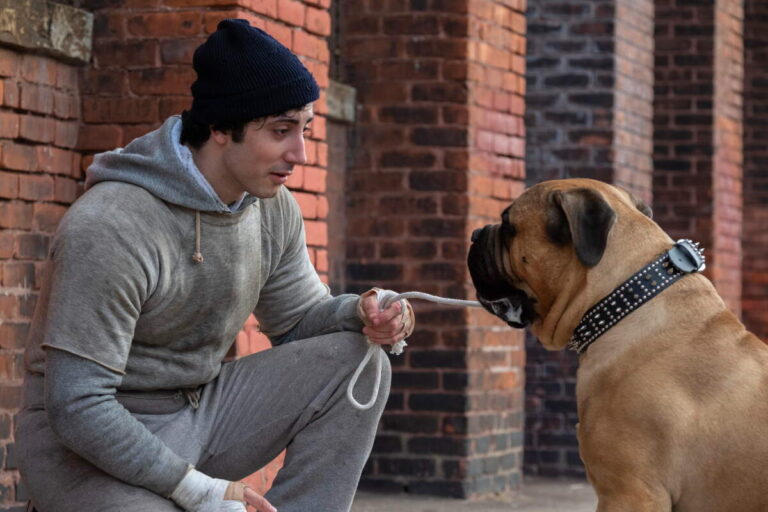
The primary reason that I Play Rocky works, though, is because of Anthony Ippolito, whose portrayal of Stallone is uncanny. Even Stallone says he was fooled by the resemblance, saying, “I actually thought it was me the first moment; there were a couple of angles. I go to my daughter and say, ‘That’s unbelievable.'” I couldn’t imagine this movie working with another actor in the lead role.
Curiously, despite neatly coinciding with the fiftieth anniversary of the original film, Stallone has formal involvement on I Play Rocky. According to Peter Farrelly, that was a deliberate decision, made with Stallone’s blessing, to avoid giving audiences the impression that Stallone had shaped a flattering portrayal of himself.
I Play Rocky isn’t perfect. There were some elements I wish were explored a little more, like the decision to shoot the most physically demanding scenes first. I was confused why the team of director John Avildsen and producers Irwin Winkler and Robert Chartoff, who were clearly rooting for Rocky to succeed, would risk injury to their star so early in production. Was this done at the behest of United Artists, which was not subtle about wanting to cast an already-famous actor as Rocky? Unless I missed something, this doesn’t seem to be answered. Stallone’s wife Sasha (AnnaSophia Robb) points it out to her husband. He shrugs, and that’s it.
I understand sacrifices have to be made for a two-hour movie, but I wish we’d learned more about Sasha Czack instead of relegating her to the role of dutiful wife. Kiki Seto also makes an impression as Talia Shire, although the movie gives her little to work with. I wish we’d gotten to see more of her.
I wrote about Club Kid yesterday, a movie that has almost nothing in common with I Play Rocky except that both understand exactly which emotional buttons to push and aren’t shy about pushing them. I knew what both movies were doing, and I fell for it anyway.
There’s something to be said for a movie that knows exactly what it’s doing, even when you do, too.
_____________________________________________
I Play Rocky opens in theaters in wide release on Friday, November 20.