

Sirāt (2025 | Spain, France | 114 Minutes | Oliver Laxe)
Amid a throbbing, speaker-rattling techno soundscape and stunning Moroccan vistas, a father (Sergi López) searches for his missing daughter with his young son and cute dog by his side. Since her disappearance at a rave months ago, these incongruous travelers have been following the circuit in hopes of finding her. Camping in a minivan alongside pilgrims to a druggy dance event that stretches through the night, they hand out flyers while lasers etch patterns onto distant canyon walls.
Director Oliver Laxe immerses audiences into this scene both with striking visuals and an overwhelming techno score that pushed the speakers at the theater I saw it to the edges of their tolerances. It’s a sonic assault, but one in service of conveying the overwhelming environment to which all of these revelers submit themselves, throbbing along in ecstatic movement, finding connections with other like-minded seekers. It’s cliché and true to say that the sound is its own character, especially here, where experiencing the film on a big screen with big speakers is essential. [The work of its sound mixing, editing, and recording has since been recognized by the Academy with a nomination for Best Sound at this year’s Oscars, where it’ll vie for the top prize against big-budget powerhouses like F1, Sinners, Frankenstein, and One Battle After Another.]
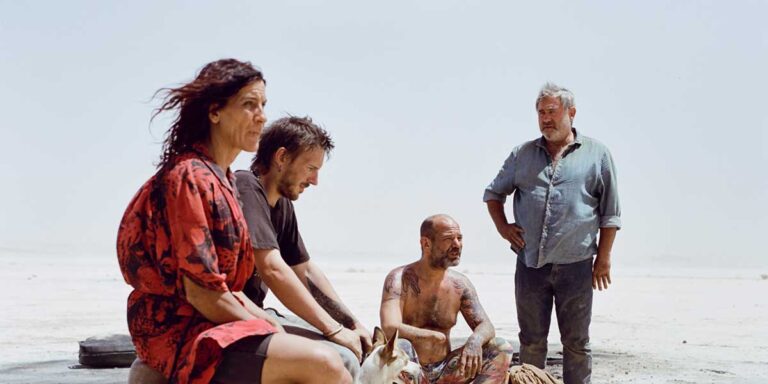
As Luis, Sergi López is perhaps the only recognizable face among a cast of new discoveries and non-professional actors. By the time the sun rises over a finally quiet morning, he and his son Esteban (Bruno Núñez Arjona), once again have come up empty on their search. They do, however, meet a small band of misfits, amputees, and oddballs on the periphery who mention that there’s yet another, more mythical rave happening even deeper into the desert.
As the outside world begins to crumble due to a dire yet unspecified conflict, the initial rave is hastily dispersed by military police. Luis, Esteban, and their adorable little dog decide to test the limits of their rented minivan and hastily follow this new band of outsiders in their big, well-outfitted, camper rigs across the punishing terrain toward the Mauritanian border. The small group reluctantly becomes unlikely guides through an increasingly perilous journey through the harsh desert, much like the myth of a wire-thin road to paradise that passes over the Inferno of Hell referenced by the film’s title.
There are surprising moments of sweetness, but the director is no softy. Shot with breathtaking cinematography and anxiety-inducing action sequences, this road warrior parable is ultimately about the stupid, futile fragility of life. The film has hugely affecting sequences that shock audiences from any sense of safety. But unlike some other cinematic provocateurs whose work I often find needlessly cruel to both audiences and characters, I’ve heard Laxe describe the film as one that embraces the inevitability of death as a necessary part of learning to live. The generosity of sentiment in this approach is evident even as catastrophe after catastrophe befalls the characters on their doomed quest.
As a cinematic experience, it is incredible, though I still find myself wrestling with its methods and message. I can barely bring myself to go car camping, let alone to live off the grid chasing sonic and chemical nirvana, so like many horror movies, I found myself able to view it from a touristic distance. While its lessons about the fragility of life are universal, for me, it reinforced a universal truth: no matter how caring and resourceful they are, never ever follow a band of aging ravers to a second location.
An earlier version of this review ran when Sirāt had its North American Premiere at the Toronto International Film Festival. It is now playing theatrically in Seattle, including a run at SIFF Uptown.