



Billie Eilish — Hit Me Hard and Soft: The Tour (Live in 3D) (2026 | USA | RUNTIME | James Cameron and Billie Eilish)
What a time it is to be a pop star. When the arena tours have done a year of sales, you can share the experience with fans who couldn’t score a ticket via the magic of the multiplex. Taylor did it with Eras, Beyonce did it with Renaissance, immortalizing their mega-shows and collecting some extra cash. Between concert films and jukebox biopics, movies that feature familiar music have become one of the surer things in a shaky industry. Now, curiously enough, it’s Billie Eilish’s turn and she’s doing so by sharing co-directing credit with none other than James Cameron and in 3D, no less. The experiment and its result is mildly perplexing.
The most glaring oddity of Billie Eilish: Hit Me Hard and Soft might be the involvement of mega-moviemaker James Cameron, briefly on shore leave from Pandora and the decades-consuming stint directing the Avatar series and bringing his fancy 3D cameras out to the stadium. Making a concert movie in 3D is honestly a decent use for the format’s limited dividends, so getting one of the best in the business to do a stint as your personal videographer is a huge flex for Billie. The results are interesting at best. Donning 3D glasses gives you a sense of the scale of the show, with its theater in the round setup, sensory overload light and flame show, and the degree to which a single performer is responsible for captivating tens of thousands of people all by herself. It’s quite impressive and the shots of the singer racing around the stage, commanding attention from outcroppings, and jogging along the edge of the crowd to countless outstretched hands are incredibly cool.
Less cool, though, is Cameron (and his co-director’s) apparent interest in verisimilitude in bringing the full arena concert tour into theaters. Maybe it’s a meta-commentary on the degree to which fans center themselves over performance, but the number of shots of sophisticated camerawork being obstructed by a wall of uplifted iPhones making their own recordings becomes quickly tiresome. In another life I had a sideline in concert photography, so maybe I’m a bit immune to the scale of these events and more than a little allergic to watching a performance through other people’s tiny screens. Even worse, though, is the catastrophic decision to put the crowd noise at the same level as the onstage performance. The roar of the crowd is one thing, thousands of people screaming along off-key is another. It might be authentic, but it’s one of those things where you have to be there to even tolerate it. If you’re not, it’s incredibly grating and emphasizes how much you missed by watching the movie instead of the show. Aside from one song where Billie implores the crowd to stay silent while she builds vocals from live loops, the din of the arena noise overpowers the performance, calling into question why you’re even sitting in a theater watching a concert film at all.
There’s something to be said for including the fans and I will say that Cameron is an outstanding crowdspotter. Throughout the performance, he catches plenty of great shots of individual fans becoming overwhelmed with emotion. It’s the reason that people go to these shows, so I don’t begrudge the inclusion of how much the music means to the thousands of young women (and a handful of young men) who spend hours waiting outside a show to be close to a musician who changed their lives. Including them in the film is an important gesture, though it often feels very surface-level.
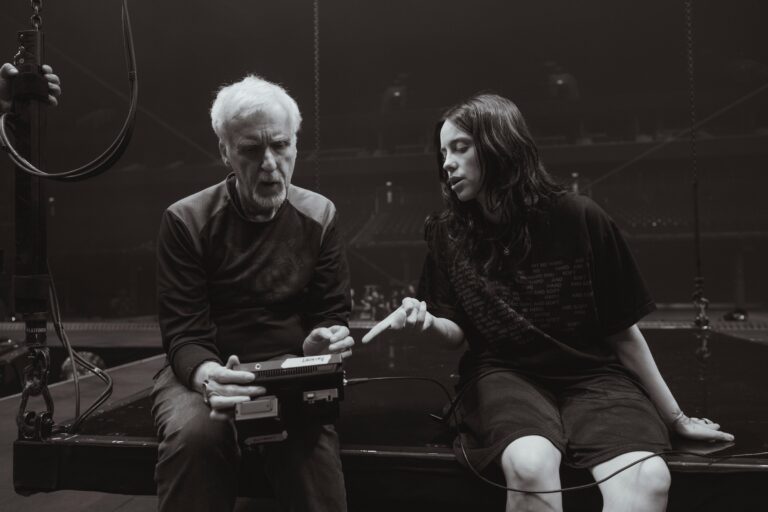
Perhaps less surprising, but still a smidge disappointing is how much of the film is purely dedicated to re-creating a concert. Unlike R.J. Cutler’s insightful and immersive Billie Eilish: The World’s A Little Blurry, insights into the subject’s life are scant. In that film we got a candid look at real life for a talented musician on a meteoric rise. It was a rare look at what it’s like to be a pop star; this movie is what it’s like to be at one of their shows with almost no personal insights. A handful of cutaways to discussions between Cameron and Eilish as they work together to conceive the look and feel of the film, establishing their joint authorship of the project. Over the course of a very short interview, Cameron tosses softball questions and Eilish gives pretty canned answers to how it feels to be her and what it takes to endure the the physical toll of executing an exhausting tour.
The sequencing is also haphazard, cutting from the show itself to seemingly random moments from the day or two prior (“show -4h”). The best cutaway goes from the opening number to the moments before, tracking Billie Eilish from backstage, into a rolling box that sneaks her into a gleaming cube, and hovering above the audience. Why it isn’t the opening shot is beyond me. These tour mechanics are the most fascinating part of the film with some of the most dynamic and surprising camerawork, yet they have a way of halting the momentum and reminding you how standard much of the musical sequences are.
Complaints about the structure aside, the show itself is very good. If you love Billie Eilish, you’ll hear almost all the hits (albeit through the din of crowd noise and 3D gimmicks like hands waving in front of your face or people blocking your view on the way to buy a T-shirt). But unlike some of the other mega-tours captured on video, Eilish’s sets aren’t especially cinematic. She proudly holds the spotlight on her own without backup dancers or other musicians (they’re playing in the rock equivalent of an orchestra pit rather than on stage). As a performer it’s a feat that emphasizes how much people in the crowd are bringing their own experiences to the arena and reflecting it back on an unlikely icon. Performing the whole set in her own style of baggy athletic gear, Eilish positively upends stereotypes for women in pop music, taking cues from rap and hip-hop in her crowd work, and setting an example for fans who don’t necessarily fit the mold either. The scale of the filmmaking succeeds in emphasizing how singular a presence she is; however, that comes with a fairly repetitive visual experience. I saw it with fans at a promo screening and there were only a few moments where anyone stirred in their seats along with the music. Maybe it’ll be a must-see for devotees wanting to re-live the tour, but might be less than compelling for onlookers curious to see what they missed.
Billie Eilish — Hit Me Hard and Soft: The Tour (Live in 3D) arrives in theaters on May 8
Image courtesy of Paramount Pictures