



Miroirs No. 3 (2025 | Germany | 86min | Christian Petzold)
With something always tantalizingly out of reach, Christian Petzold’s films carry a certain rigor of academic riddles, albeit koans populated by characters nursing their own quiet tragedies. With vibrant interiority, Paula Beer’s melancholic university music student becomes a makeshift bandage for a rural family in the wake of a freak car crash. With a fairy tale quality, it becomes a story of parallel rebirth and healing. The great pleasure is in waiting for the final puzzle piece to fall into place, revealing an unexpectedly richer, fuller whole.
Opening with a dreamlike quality, we first encounter Laura (Paula Beer, Petzold’s current muse) in quiet contemplation of a waterway below an ugly Berlin overpass. Exploring further, she explores the shoreline below where a shadowy stand-up paddler glides past silently, evoking a ferryman traversing the worlds of the living and dead. In her cozy, loose-knit pink duck-emblazoned sweater, she’s a young woman adrift in a fog of her own isolation. Having misplaced her bag, she arrives home to her apartment to a boyfriend annoyed that she’s been out of touch and late for a convertible ride to the countryside for a boating excursion with influential musician friends. Her boyfriend is the sort to pick up an interesting synth, trust his girlfriend to identify the key of a classic Dutch pop song on the car’s stereo, but not sensitive enough to care why she immediately wants to leave rather than spend the day on the lake.
Even here, in approximately the modern day and real world, Petzold’s filmmaking has a surreal yet naturalistic quality. Laura and an older woman standing alone, staring blankly from the curb of a country road, exchange portentous glances as their car speeds by. The encounter will repeat moments before an offscreen car accident causes her boyfriend to exit the film while Laura walks away miraculously unscathed, albeit even further dazed.
That woman, Betty (Barbara Auer, also in her third collaboration with Petzold), is the first to arrive on the scene of the crash. She brings Laura away from the wreckage, back to her house. Of her own volition, Laura requests to stay in the company of this apparent stranger rather than returning to her home or to seek further medical attention. Perhaps more oddly [or merely German civic-mindedness], Betty immediately agrees, setting Laura up with a bed, competently unobtrusive room service, a change of well-fitting clothes, and enrichment activities out of Tom Sawyer like helping to paint her white picket fence.
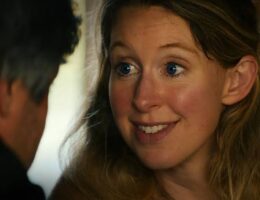
From the small disarrays of the country house, calling Laura by the wrong name, and the way that Betty’s estranged husband (Matthias Brandt) and adult son Max (Enno Trebs, both also fellow Petzold three-timers) assume she’s gone off her pills when she invites them to dinner and they find a table set for four, it’s fairly easy to deduce the nature of the unresolved absence in their family’s life. They’re men of few words, mechanics who work from their own shop with a sideline in modifying electronic tracking systems in wealthy clients’ high-end automobiles. More comfortable working with their hands than expressing themselves, their long silences and meaningful eye contact upon seeing Laura speak volumes. It’s a credit to the expressive quality of the entire cast’s acting that so much of the storytelling happens through wordless gestures and silent reactions, but this is especially true for how Paula Beer’s big blue eyes work wonders to connect us to a character whose distresses may be a mystery even to herself.
As the days of Laura’s respite stretch on, her presence becomes a balm for a fractured marriage. Even as she gets to know Max, sharing beers and listening to music (an impeccable Frankie Valli needle drop) while he repairs a broken bicycle to help her get around, he remains unsettled by her presence. For much of her stay, nothing really happens — meals become less awkward, a dishwasher breaks, the merits of plum cakes are debated — but the oddity of the days stretching on without anyone daring to broach the subject of why she’s there contributes to a sense of quietly mounting unaddressed tension. Amid seemingly aimless summer days soundtracked mostly by breezes and birdsong, Petzold balances coziness with borderline unbearable eeriness.
Neither dream nor nightmare, the spell of must eventually break. As the charade comes crashing down around them all and its absurdity comes into focus, the severance reveals that grief, trauma, and recovery rarely proceed in straight lines. Instead, recalibrations come in fits and starts. Stasis gives way to forward movement in the afterglow of brief surrender to respites of fantasy, be it indulging in echoes from the past or succumbing to an unspecified desire to temporarily disappear from the world. Even upon awaking, shaking off the confusion, the world continues with a new sense of normalcy. You can leave the past behind, but still you can never leave more than you found.
Miroirs No. 3 continues its theatrical rollout in Seattle this weekend, with screenings at SIFF Uptown.
An earlier version of this review appeared as part of our coverage of the 2025 Toronto International Film Festival, where the film had its North American premiere.