
Double Freedom
(2026 | Chile/Argentina/Luxembourg/Germany | 100 min | Lisandro Alonso)
Lisandro Alonso’s Double Freedom (Spanish title La Libertad Doble), is a quasi-remake of his 2001 debut, La Libertad, one of the most important art films of the 21st century. Shot with a crew of ten people, La Libertad observed a day in the life of Misael, a young ranch hand who worked at the Alonso family’s farm. The film observes Misael as he goes about his daily routine, felling trees, selling lumber, and (in)famously, capturing, butchering, and eating an armadillo. A slow film about slow labor, the film was a sensation that spoke directly to questions surrounding slow cinema aesthetics and their antagonistic yet inextricable relationship with a culture of globalized hyper-speed. Just as important was the film’s blurring of fiction and documentary, its artifice so ambiguous, its direction so meticulously neutral, that it represented a freedom not just from society and industrial production methods, but genre distinction altogether. Alonso’s project would clarify through the rest of the 2000s as the dual odysseys of Los Muertos and Liverpool explored capital’s infectious spread through remote Argentinian communities, but La Libertad remains his most singular achievement as one of cinema’s most thrillingly open and mystifying achievements.
La Libertad Doble is a back-to-basics proposition for Alonso after the hellish shoot of 2023’s Eureka, which marked the director’s first film set in the United States and his second collaboration with Viggo Mortensen after 2015’s Jauja. Alonso has publicly stated that these two films made him want to quit filmmaking altogether, so the decision to return to La Libertad and its independent production methods is a rare case of a director deciding to “size down”, attempting to reject this new environment of MUBI and NEON-produced international coproductions and the outsized power of Western European film funding.
More than anything, La Libertad Doble is about how you couldn’t make La Libertad today. This is clear from the opening shot, a continuation/recreation of the original’s bookended images of Misael sitting by a campfire eating armadillo, wearing the exact same outfit he wore 25 years ago. The impossible continuity (see also: the “same” dog) immediately breaks from the original’s docu-fictional veneer, and as Misael uncannily goes through the same routine with minor variations (e.g. he pooped in the woods in the original, but pees here), we’re keenly aware that on some level, he’s simply going through the motions. There’s a startling effect to watching these images, especially because no one expected a remake of this particular film, and the past 25 years have only honed Alonso’s craft. This isn’t a shot-for-shot remake. There’s so much rigor in the elongated static framings and the dense sound design that Doble feels more constructed than the original, but also more emphatically beautiful.
It’s both shocking and inevitable then, when a narrative emerges. Misael receives notice that his sister, Micaela (Catalina Saavedra), is being released from a mental institution on account of budget cuts. While La Libertad only featured Misael’s family through a brief phone call, Doble follows Misael as he picks up Micaela, and eventually brings her back to live with him. Micaela’s introduction serves a dual purpose, simultaneously illustrating the unfeasibility of Misael’s Edenic lifestyle in Argentina’s contemporary political conditions, and the impossibility of Alonso’s placid, unglamorous style in today’s filmmaking ecosystem (case in point: Cannes didn’t see fit to program Doble, a sequel to one of its most famous 21st century premieres, in its official selection). The title is ultimately quite literal, encompassing two characters, two days, two ironic notions of freedom, the IP-ification in the numbering a representation of capitalism’s reach into cinema’s margins.
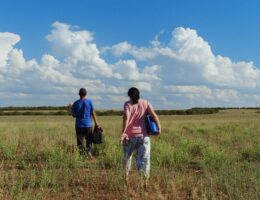
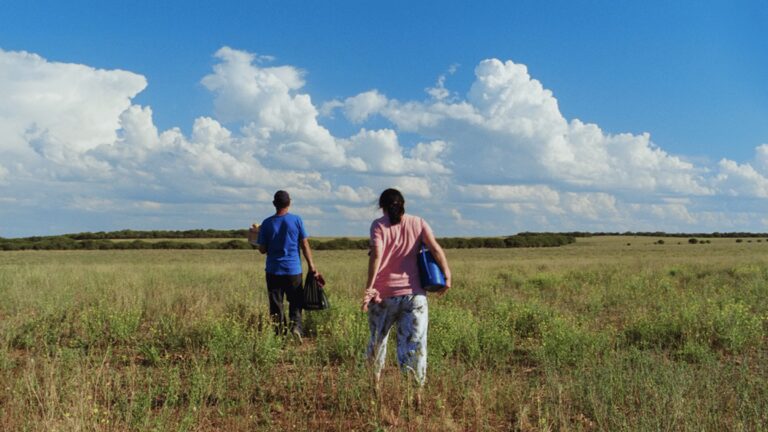
Micaela reconfigures the film into a triptych, one that’s remarkably similar to Eureka. Like that film, which also opens with pastiche, the standout middle segment of La Libertad Doble, in which Misael visits the institution, with its sullen gray interiors and the striking image of a slumped body in the foreground, has a similarly nightmarish Lynchian quality. When Misael and Micaela return to the farm with their newfound pressures, the tone is sober, but not really despondent. There’s an intriguing mystical quality (like the last segment of Eureka), especially when Micaela drifts off into the forest on her own, imposing her own freeform sense of time, and the pair seem to take these new conditions with the same opaque melancholy as the opening. That tonal equilibrium eventually feels obstinate, defiant, even, especially when we see the pair walking through an open field, finding their way through the mythic, solitary expanse.
Alonso’s own defiance appears in the post-credits scene, one of the greatest in recent years, which shows the original ending to La Libertad that the Cannes selection committee forced Alonso to cut 25 years ago. In a nod to Taste of Cherry, a young Misael turns to the camera and laughs. Back then, such a gesture might have played like jovial gamesmanship, but in 2026, it’s developed into something crushingly bitter.
Double Freedom plays at NYFF on October 5, 8, and 12. It is currently seeking distribution.