




The Social Reckoning
(2026 | USA | 121 minutes | Aaron Sorkin)
The Social Network, about a Harvard nerd turning his longing for connections into a world-devouring platform, is among the greatest wide-release films made in this increasingly dismal century. Working from a rapid-fire script from Aaron Sorkin, David Fincher discovered an film that was emblematic of the times, in large part due to a brilliantly realized and thorny lead performance from Jesse Eisenberg that intercuts between a present day deposition to expose the past, we see the founder transform from a lonely college kid, oblivious to social cues and drunk on nascent power, into a lonely executive, guarded against the slings and arrows of a lawsuit aiming to take a piece of his kingdom.
Since then, the world, our relationship to social media, and its relationship to the world have changed dramatically and almost entirely for the worse. So it makes sense that all these years later, Sorkin has returned to the well of the Facebook. However, in what’s becoming an unfortunate pattern, someone in power at a movie studio has made the catastrophic decision to allow him to direct his own script. At one point in his career, he may have been gifted enough at spinning out enough crackerjack dialogue to cover up other flaws in storytelling and characterization, but in my experience his scripts have been better served by being produced by someone with enough skepticism and influence to counterbalance the writing. Here, there’s no such ballast, and the film suffers greatly. Cringeworthy throughout, it’s so blind to its own faults that its already-dated revelations make for a dull retelling of very recent history.
Like its vastly superior predecessor, The Social Reckoning uses Sorkin’s favorite device: cross-cutting between interconnected episodes in history. The first thread concerns a Wall Street Journal reporter beginning to dig into the algorithmic practices of Facebook in 2019. The other finds Facebook’s CEO being prepped by image consultants in a theater-style war room for impending congressional testimony in January of 2021. Spoilers for recent history, but astute audiences might remember that something else Facebook-related also happened in that month. Spoilers for the way Sorkin writes: there’s some fudging of timelines to get all of these pieces to fit together for the sake of drama, especially if it provides occasions for monologues, especially if they’re repetitive ones.
To that end, the film opens with one of his favorite tropes: a woman who seems very smart but is maybe actually kind of dumb and definitely evil. Here, it’s an attractive blonde woman standing on the side of the road next to a car experiencing mechanical trouble. The police come to her assistance, smell alcohol on her breath, and are confronted with what to do. For a minute, you think this drunk lady is outsmarting them (she’s not actively driving after all) until the plot turns and she reveals herself to be a monstrous MAGA-style influencer who captures the venomous exchange for online clout. It’s painful to watch this once and Sorkin will return to it over and over again within the frame of the movie to hammer home what’s a fairly obvious point to anyone alive in the year 2026.
Back in the real world we meet our two protagonists. Mikey Madison plays a socially isolated Facebook data engineer (Frances Haugen) who’s been running some classifiers as part of the platform’s perfunctory and much-ignored Civic Integrity Team. Sorkin lets you know she’s smart by the way she wears glasses and armwarmers, but emphasizes her ineffectiveness in the way she piles all her speeches onto note cards, info-dumps statistical modelling language to uninterested colleagues, and snappily corrects her troglodyte coworkers about their misunderstanding of mythology. Elsewhere, we meet Jeremy Allen White as a virtuous but perpetually befuddled Wall Street Journal reporter Jeff Horwitz just as he’s rolling in late to an important pitch meeting in San Francisco. Despite wanting to do an extensive investigation of a powerful tech company, he’s presented as an incredibly ignorant and underprepared, a thirty-something who has managed to have missed the boat on all aspects of modern-day technology. Unaware of how to use Google Maps (or take an Uber from the airport) and seemingly never having directly interacted with social media platform, he’s a perfectly odd fit for the assignment he chose for himself. Maybe the real Horwitz (who graduated prep school in 1999, went to Pomona, and did a fellowship at Columbia) was actually so oblivious at the time, but as a character on a big screen the comatose level of awareness makes for tough sledding as a protagonist.
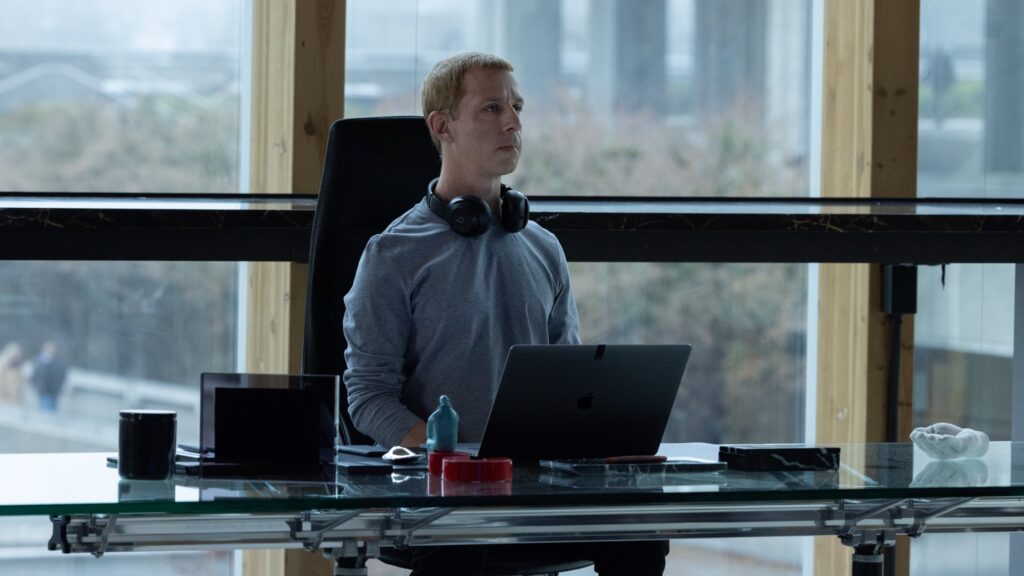
The second main piece of the story finds us in 2021, with Jeremy Strong playing Mark Zuckerberg as he’s forced by his handlers into rehearsing answers for an upcoming session in front of Congress related to the platform’s practices as they regard to political speech and advertising. If I had one hope for this movie it would be that it was at least justified by a fascinating performance by Strong, but alas all of his Method is in vain. He portrays him as an openly sociopathic robot, a flimsy stereotype of the far reaches of the neuroatypical spectrum. Any complexity or humanity from the role created by Eisenberg in The Social Network is long gone, washed away by the billions of dollars and godlike insulation of monarchic moguldom of the intervening decades. Here and in flashbacks, Strong shows the character rarely feigning an interest in even appearing human. The spiteful and short tempered persona approximately works as a punchline, but grows tiresome very quickly.
Most of the film’s time is spent on Horwitz’s reporting that would become The Facebook Files, a feat that apparently resulted from one very fortuitous response to spamming a bunch of Facebook employees with LinkedIn messages. Looking to find out whether comments are being filtered, he’s essentially handed a much much bigger story by Haugen, who despite loving Facebook and its mission (despite her constant mistreatment and disregard) has seen some alarming statistics about the catastrophic societal effect of the platform’s newfound focus on “engagement” as a key metric of success. The grand reveal is another place where fast pace of history works against Sorkin. Even with a personal angle as motivation from a source, a thirtysomething reporter discovering how a social media platform works and whistleblower revealing that reposting vs. simply liking hateful content drives people toward hateful groups now feels painfully self-evident.
Even when retelling history, one could hope that the docudrama form has the power to make a complex problem engaging or the process to discover the truth to be fascinating. Unfortunately, the decision to portray Horwitz as an idealistic idiot (perhaps as an audience stand-in) deeply backfires. From the vantage of 2026, the revelations not only seem obvious, his inability to understand the things that Haugen is telling him, let alone to have done any homework beyond pestering his perpetually abusing his interns, makes for a dull series of discoveries. Even when she’s styled like her character in Anora sneaking into hotels (apparently to deflect attention), Madison does what she can to make her portrayal of a brave whistleblower carry the weight of the immense personal risk that she’s taking to give this reporter a career-defining story, but she’s really left out on a limb in terms of scene partners.
It’s not entirely Jeremy Allen White’s fault, but he’s playing a man who doesn’t know anything about social media, has never hiked, hasn’t heard of celiac or gluten intolerance (see above about having gone to Pomona and Columbia), barely understands simple charts and graphs. It’s hard to take him seriously as a reporter, let alone as a human being who was alive and in the world. Sorkin seems to love him to the point that he lets him drop a terrible ‘mansplaining’ retort in the middle of an argument. Even the audience at the press screening groaned. Sorkin’s dialogue is allegedly his strength, but it only works when we have reason to believe the characters are too smart for their own good. Without that foundation, and applied to paper thin characters, the wordplay is annoying and repetitive. What should be a movie about journalistic fireworks plays out more like soggy cereal barely snapping or crackling let alone ever popping.
You can feel the filmmakers realizing that part of the story is a dud in the way that the finale seeks to heighten the stakes (with something that feels fudged, timeline wise) with real world implications. Just as Jeremy Strong’s version of ZuckerBot is almost roused from his shell in a stand-off with a former colleague (Bill Burr as Charlie Garrigan, seemingly brought in for the sole purpose of undermining the competence of Wunmi Mosaku’s crisis manager) over a pet issue of fact-checking political ads, all hell literally breaks loose. What had been building to a journalism bomb dropping shifts instead to the actual world breaking. The instinct to thread this needle makes sense, but it also feels like a hackneyed ploy and a desperation move, compete with an eye-roll callback that’s far Too Cute. Zuckerberg is so sidelined and limited in his dialogue that one wonders about terror of impending lawsuits in determining exactly what words could be uttered during the film. Regardless of the decision tree, the result is near-comedic in its simplicity.
With little in the way of visual panache (cinematographer Jeff Cronenweth returns, but everything looks like Vancouver or a hotel room) or sonic excellence (gone is the iconic Reznor/Ross duo that innervated Network), the lack of storytelling innovation falls flat and fails the actors. You almost feel bad for Jeremy Strong having to get such a terrible haircut living as this character for not very much in the way of a return. Ironically or not, the final moments call back to a scene in which Horwitz explains the happiness of overtime-enabling buzzer-beater to Haugen in neither of them knowing the result of the overtime (even weirder: the game they’re watching almost certainly did not exist). As the audience, though, we don’t need the novel’s worth of end title cards to know what came of all the risk and reporting. Even a few years after these events, the air is completely out of the story and the writer/director is nowhere up to the challenge of trying to make sense of that unfortunate but true reality.
The Social Reckoning arrives in theaters on October 9
Images courtesy Sony / Columbia Pictures