


NAZA
(2026 | UK | 80 minutes | Yuval Abraham and Rachel Szor)
Yuval Abraham and Rachel Szor (part of the Oscar-winning collective behind No Other Land), have returned with NAZA. Now playing in theaters, and soon to follow online, it is another striking piece of documentary and journalism that illuminates the horrors of the last three years in the conflict between Israel and Gaza.
The most effective pieces of No Other Land, the Oscar-winning documentary, happened at night. Outside of its first-person documentation of the resistance to regular Israeli military incursions into the Occupied West Bank, the candid conversations and burgeoning friendship between an Israeli journalist (Yuval Abraham) and Palestinian activist (Basel Adra) underscored the gulf between the freedoms accorded to them in their daily lives as well as the constraints on their future aspirations. Growing close to them while made the portrayal of inhumane treatment, government betrayals, and ceaseless harassment in the destruction of Masafer Yatta all the more enraging.
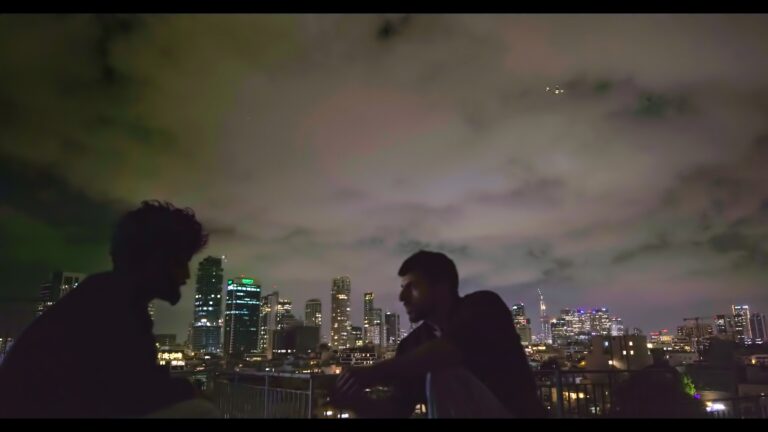
With NAZA, they double down on the conversational theme, entirely structured around late-night talks. Here, though, they’re interviews conducted on Tel Aviv rooftops over the course of the last three years. Yuval Abraham is back in a journalistic role and we watch as he speaks to nearly two dozen members of Israel’s military whose voices and appearances are disguised to protect their identities. Both films feature revelatory talks in the evening shadows, but where No Other Land’s were heartfelt connections, these use the privacy afforded by the remote locations and twilight shadows to chilling effect. Where the specificity of No Other Land left me so angry and heartbroken I wanted to throw rocks, NAZA’s big-picture approach to revealing systematic practices of state violence is a kind of infuriating from which there is no coming back.
With very limited archival footage, conversation remains the fundamental currency of the documentary. In place of re-enactments or sophisticated graphics, concepts are illustrated by the men (and women) describing the practices of the IDF in Gaza with hand-drawn sketches. As we watch them put pen to paper to outline bombings of apartment blocks or the positioning of snipers on food lines while candidly describing casualty counts, it’s like a very low-fi rendition of The Act of Killing. All the while, the camera often cuts away to calm, methodical scenes of urban life viewed through Tel Aviv high-rise windows. Filmed at a distance, these narcotizing montages play like one of an AppleTV screensavers that I’d zone out to while having a dental procedure, though my hygienist invokes far less pain. The submissive effect of the long-distance photography alongside the matter-of-fact revelations makes for an eerie contrast with what the scenes they’re describing in Gaza, only 44 miles away.
Structured over several chapters, the film opens with a historical wide lens, detailing the degree to which constant Israeli surveillance was built into the West Bank from the very origins of its telecommunications infrastructure. We hear how this constant scrutiny has evolved from the practice of anti-terrorism into a system of modern warfare that has become deeply reliant on computer models and artificial intelligence. The film’s title is taken from the internal terminology used by the IDF to calculate the “acceptable” number of civilian casualties for any given operation in a war increasingly conducted at a distance with bombs and drones.
As these soldiers and operatives talk about their work, it reveals the degree to which compartmentalization has served to insulate the practice of war from the people practicing it. Targets are determined by AI models applied to communication networks; casualties are left to equations; the humans are just doing their job as a cog in a giant machine. To an extent, these discussions apply to broader issues in the ways that wars are now conducted across the globe. That death can be dealt so easily from above with so little emotional toll is frightening in general, but as applied to the asymmetrical conflict playing out in Gaza, there are harrowing specifics.
A frequent thread is the ease by which the system enables an abdication of responsibility, even after describing the hundreds or thousands of civilians whose deaths they personally oversaw on a given day. Some acknowledge that the operations were “insanely fun”, akin to completing caffeine-fueled levels on a video game. Others, when challenged, several of the interviewees acknowledge that in the abstract, the actions they describe would constitute war crimes. Most participants must feel disillusioned enough by the system to have participated in the documentary; but few — even with disguised voices — sound as if they’re haunted by the role that they played. There’s always someone or something above whose orders were being followed. Some have left the service; others still believe in the mission. Given the banal tone by which some describe their participation in a genocide as part of a high-status, well-paying job, that Jonathan Glazer (The Zone of Interest) is an executive producer.
Most of the individual revelations deriving from these conversations have already been published (in The Guardian, which will release the film online after its theatrical release). So there is not necessarily a bombshell contained here to grab headlines. However, collecting all of these stories into one concise piece, though, has an impossibly profound effect in describing a systematic government practice of unrelenting violence. As a documentary, it is an artful depiction of heroic journalism. For much of the audience who goes to see this film, it will serve as a brilliant synthesis of the awful shape of this seemingly endless crisis. One can hope that for others it will mark a clear bright line that irrevocably awakens an horrible understanding of the unfolding genocide.
It is horrifying to see little drawings translated to the vast numbers of civilian lives taken in service of killing low-level targets of suspected terrorist involvement. Tallies grow, the “acceptable” ratios stretch to absurdity, boggling the mind of the viewer and occasionally even the interviewees as they recognize the scope of death they’ve dealt. Hearing in plain language the degree to which the flattening of the Gaza Strip is the point of the mission is clarifying toward what anyone with eyes has long suspected. Acknowledgement that the intentional constraint of humanitarian aid is intended to force migration and induce fear reinforces what most external observers have been shouting. But it is the anecdotes about watching (or causing) unspeakable cruelty and suffering, often at the distance afforded by the remote surveillance operation, that are the film’s most searingly unforgettable. The stories draw the breath right out of you.
Still, most of the masterful film leaves the ground-level view of Gaza to our imagination. Throughout, Yuval remains impossibly unreactive, allowing the cavalcade of self-indicting revelations to proceed in abhorrent detail. The pictures these stories and sketches conjure are indelible. When the film finally shows actual footage on the ground, it’s so much worse than you imagined. A must-watch documentary, among the most important of this year or any other.
Naza arrives in local theaters on October 9, including a run at the SIFF Uptown.
Image courtesy of the Guardian