



Saturday Night (2024 | USA | 109 minutes | Jason Reitman)
Jason Reitman’s hyperkinetic dive into the unbelievable 90 minutes of chaos before the first ever episode of Saturday Night Live is anything but a study in extreme competence. Not having read Live From New York, the celebrated oral history of the landmark show, I went into the Telluride premiere assuming that getting such an unconventional project off the ground must have required unprecedented levels of organizational genius. But of course it didn’t. It was 1975 and weekend late night programming was an untested battleground. Instead, in this tall telling of the tale of the first Saturday Night, we find ourself among a bunch of ragtag comedians, writers, and performers intent on building the plane while still flying it. That is, if they even get the rickety aircraft to the tarmac, let alone off the ground.
Rather than revealing a grand design of a what would-be historical late night comedy, Reitman sets his attention on a tight window to show us just how uncertain and unlikely the show’s exceptional longevity would have seemed in the minutes leading to its first live broadcast. He sets a ticking clock — approximately an hour and a half, with some wiggle room — and throws us right into NBC Studios where a cast and crew are still rushing (with various levels of urgency) toward going on the air at 11:30 EST. A NBC page is on the street handing out flyers to recruit an audience for a free show. There’s a llama in the loading dock, lights falling from the rigging, and too many notecards on the board representing sketches, musical performances, stand-up appearances, and other parts of the variety hour on the board to ever fit into the show’s runtime.
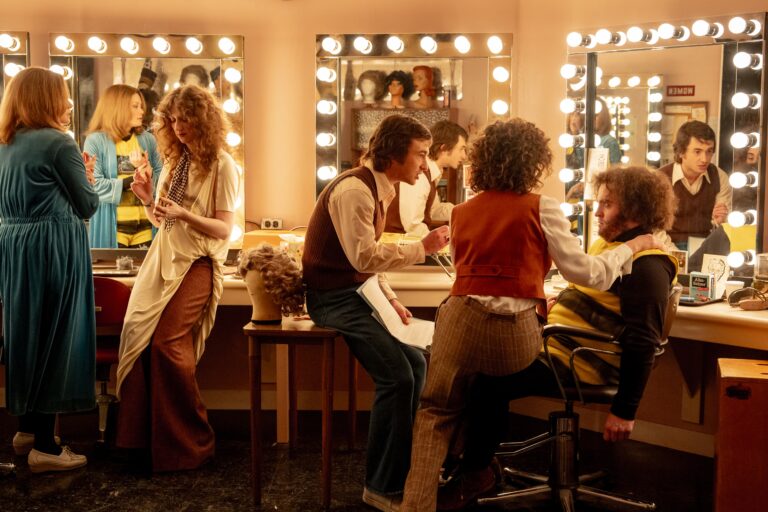
It’s an incredible scene of jittery anticipation, studied laziness, and blasé professionalism across the cast and crew. Reitman and co-screenwriter Gil Kenan claim to have talked to “everyone” they could to get the best stories (whether they all happened exactly that night and exactly as portrayed strains some credulity, but with the connections they have, who really cares when the recollections are this much fun). Cinematographer Eric Steelberg’s camera is free to roam the a marvelously detailed, ephemera-stuffed, multi-story replica of the legendary studio built by production designer Jess Gonchor. Incorporating a facsimile of the studio into the lighting design allows the action to zig and zag freely throughout the building, captures the freewheeling atmosphere of performers chatting between last minute rehearsals, writers frantically punching up bits, craftspeople finalizing sets and checking lighting cues (to disastrous effect), and skeptical executives ready to squash the whole thing before it launches.
But most of all, this open geography allows us to follow the movie’s hero, Lorne Michaels, as he attempts to corral the brewing storm into a symphony that will convey to the country how a great night in New York feels. Fresh off of playing baby Spielberg in the Fabelmans, Gabe LaBelle adds the SNL godfather to his resume of portraying titanic figures of the last half century of popular entertainment. He’s a bit younger than Michaels was at the time, but it enhances the film’s perspective of a boy genius at the helm. He charges through the evening with the certainty that the show he’s created is going to be something special, though even he doesn’t yet quite know what it’s going to be. He’s a compelling youthful presence who makes you believe that this kid who’s way out of his depth might also just be onto something.
It’s this sense of importance that’s bound to irk some viewers. On the one hand, Reitman’s film requires audiences to know what the show will become and to share his awestruck wonder at how it all began. Conversely, if you’re too deep of a SNL scholar, you’re probably going to hate this movie as an oversimplification that doesn’t get everything exactly right. But as someone who hasn’t watched the show from cold open to closing credits in decades, I found the whole frantic mess of creativity, improvisation, personality clashes, and determined ingenuity to be — much like the show itself — to be a pretty amusing if imperfectly uneven way to spend an hour and a half.
LaBelle’s surrounded by a similarly talented young cast of young talent and delightfully familiar faces. Without resorting to impressions of impressionists, they situate the show as being at the bleeding edge of up-and-comers. Chevy Chase is a handsome-faced egomaniac (Cory Michael Smith) already at odds with the tortured schlubby artistry of John Belushi (Matt Wood), who refuses to sign a contract, wear the bumblebee costume, or even shave before showtime. Jane Curtin (Kim Matula), Gilda Radner (Ella Hunt), and Laraine Newman (Emily Fairn) compare notes on who’s getting the most scenes, being required to play the ditziest, and scheme on how quickly they can accomplish a costume change. Dan Ackroyd (Dylan O’Brien) is a hilarious flirt, but isn’t so sure about being objectified for his body. Classically-trained Garrett Morris (Lamorne Morris) isn’t entirely sure what he’s doing here with all these kids.
Catastrophes abound. The week’s host, George Carlin (Matthew Rhys) won’t wear a costume. Milton Berle (J. K. Simmons) is whipping out his enormous dick to seduce cast members. To the anguished dismay of Jim Henson (Nicholas Braun), none of the writers “get” his beloved Muppets, but Andy Kaufman (also Nicholas Braun, inexplicably) is on the periphery ready to swoop in to save the moment through bizarre genius. There’s also the matter of Billy Crystal (Nicholas Podany) losing his place in history by steadfastly refusing to cut his stand-up set short enough to make it onto the show. All along the way, Jon Batiste is playing bandleader Billy Preston, while also composing the film’s propulsive improvisational original score live on the set.
Amid all this turbulence, there’s the matter of how Lorne’s wife Rosie Shuster wants to be credited in the closing credit. Among so many flashbulbs, the standout performance by Rachel Sennott brings comedic and emotional intelligence to human relationship at the core of the show. Even though she’s maybe kinda sort of definitely sleeping around on him (or is in an open relationship that everyone but Lorne is acknowledging), they’re still summer camp sweethearts and her decision on which last name to use means the world to him. While compartmentalizing that marital anxiety, Michaels is also dealing with wondering if his best friend Dick Ebersol (a terrific Cooper Hoffman) is really on his side in a network power struggle that’s using SNL as a pawn in a gambit with Johnny Carson.
It’s so much to cram into a hundred odd rollicking minutes, where quiet moments are vanishingly rare. If you’re someone (like me) who isn’t happy until his group vacations have an accompanying Google Doc, the level of disorganization is deeply unsettling. While whole thing is perpetually careening toward disaster, albeit one that flatters the viewer’s nostalgia and treats our knowledge as a safety net. Frustrating at times and deeply self congratulatory throughout (there’s a magical scene with an unsubtle metaphor likening the show to Prometheus), just like the determined showrunner he’s portraying, LaBelle’s performance wills the whole thing into being. As the clock counts down to showtime, the film snaps into an emotional focus and the cast aligns in a sense of purpose: the miraculous alchemy of coming together in a shared sense of urgency to put on a show, if only to prove the bastards wrong. That it works is its own incomparable sort of infectious thrill.
A previous version of this review ran when Saturday Night had its world premiere at the 2024 Telluride Film Festival. It opens theatrically in Seattle on October 11th.