



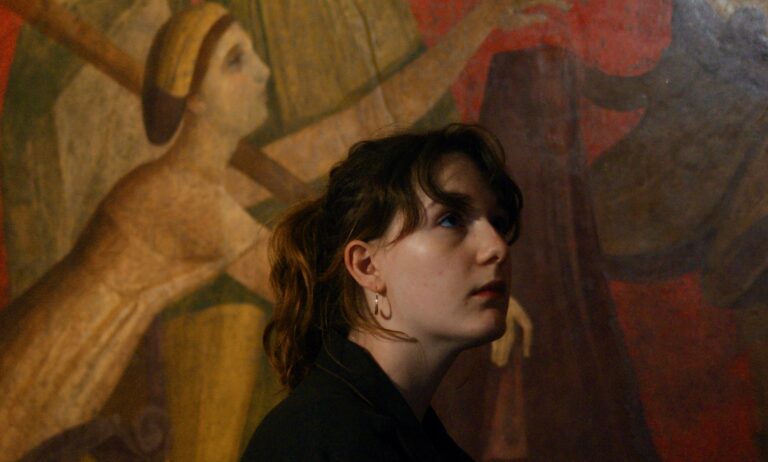
La Gradiva
(2026 | France | 145 min | Marine Atlan)
There are so many fantastic French coming-of-age films that to direct one, especially one as self-consciously grand as Marine Atlan’s La Gradiva necessitates contending with that most hallowed of national traditions. In some ways, La Gradiva is an epic-sized version of countryside group portraits like Graduate First or Wild Reeds, following a class of French high school seniors on a field trip to Pompeii just before they receive their college admissions results. Amidst the ruins of the ancient city, the film is about a group of children on the cusp of adulthood who in the process of connecting with ancient tragedy, find themselves confronted with their own mortality.
As a setting, Pompeii is of course not just a site of historical ruin, but an important cinematic space as well. As Gianfranco Rosi showed us last year, Naples is shaped by both the classical myth of Vesuvius’s eruption and the cinematic myth of Rossellini’s early modernist work in the 50s, namely Journey to Italy. The tension apparent in the premise, namely the ancient vs. modern, connects to rather clear formal tensions, a consistent clash between the naturalist and the mythical that while not always successful, makes for a particularly ambitious and well-made feature debut.
For La Gradiva’s main character, Toni (Colas Quignard), Pompeii also carries significant personal mythology. In the extended opening conversation, set on a train ride passing through a series of tunnels, he recounts the tragedy of his grandparents who suffered through an earthquake in the 80s and were forced to uproot their lives, moving to the outskirts of Paris. Hoping to learn more about his family history, Toni’s trip to Pompeii carries the weight of familial scars, and as we eventually learn, the series of still images that accompany La Gradiva’s opening credits derive from his personal archives. A problem child in the Pialat-ian mold, Toni is a sensitive soul harboring a not so secret romantic obsession for his straight best friend James, as liable to disrupt class with his antics as he is to skip it entirely for a Grindr hookup.
Though La Gradiva certainly counts as a group portrait, it is primarily about Toni’s tragedy, the way everyone around him downplays the signs of his distress in the face of seemingly grander myths without realizing they’re part of one themselves. To be fair, Toni doesn’t make it easy on them, and although his acting out is annoying (mostly making jabs at fellow students and their exhausted teacher Ms. Mercier), he never does anything so drastic as to warrant immediate attention. Even after we discover that the film is told from the perspective of Suzanne, the class’ star student, the signs don’t always seem clear.
Toni’s fate presents something of a problem for the film, which ultimately feels like a series of calculations designed to teach these students a lesson. There’s almost a sense that a more mundane coming-of-age film isn’t enough, even though the film is at its most thrillingly open during densely conceived class conversation sequences, where Atlan sketches the intersections of race and class that run through the group in seductive, utterly convincing naturalism. Atlan’s overall framing device, along with her research-heavy immersion into the lives of these first-time actors, is reminiscent of Valeska Grisebach’s Longing. As opposed to Longing’s fragmentary interest in the textures and routines of rural Germany, irreducible to the myth consecrated at the end of the film, the retroactive effect of La Gradiva’s climax makes the film feel just a bit too polished. On a moment to moment basis, though, La Gradiva is very impressive. I would happily watch Atlan’s next film.
La Gradiva plays at the Vancouver International Film Festival (VIFF) on October 2,3, and 9.
Image courtesy of 1-2 Special who will release the films in UW theaters on December 18