


Undertone (2025 | Canada | 93 minutes | Ian Tuason)
Full disclosure: For nearly four years now, I’ve dealt with the physical and mental decline of both of my parents, as well as the death of my father in 2024.
Caring for a loved one nearing their exit from this world—and the aftermath when said exit’s complete—represents one of life’s most massive seismic shifts. And undertaking that journey spurs a complex, often contradictory, and sometimes paralyzing mélange of emotions.
It also, from my perspective at least, intensifies art’s impact. Movies that might’ve barely registered on me emotionally before July of 2022 can set me, unexpectedly, to blubbering like a toddler when viewed through that life-altered lens.
Horror movies often tap into the intersection of mortality and grief with a disarming fidelity seldom present in more literal-minded, non-scary mainstream movies. It’s one of many reasons I love the genre. Alongside the rollercoaster endorphin rush and dark escapism that draw me inexorably to them, the best horror films also serve as catharsis of the most profound variety.
Given all the above, I’m the prime audience for Undertone, writer/director Ian Tuason’s feature film debut. It’s even partly inspired by the passing of Tuason’s parents (a heartfelt dedication to them caps off the end credits).
Sure enough, the freshman feature filmmaker delivers a well-acted and often technically ingenious horror film with the laudable goal of being something more resonant and liminal than your average assembly-line shocker. Staunch elevated-horror advocates A24 Films are ponying up their reputation and marketing muscle to distribute the movie. And critical reaction’s been largely positive as of now.
It therefore hurts my heart greatly to be an outlier here. Truth be told, for all its great intentions, promise, and winning elements, Undertone misses the mark from this corner.
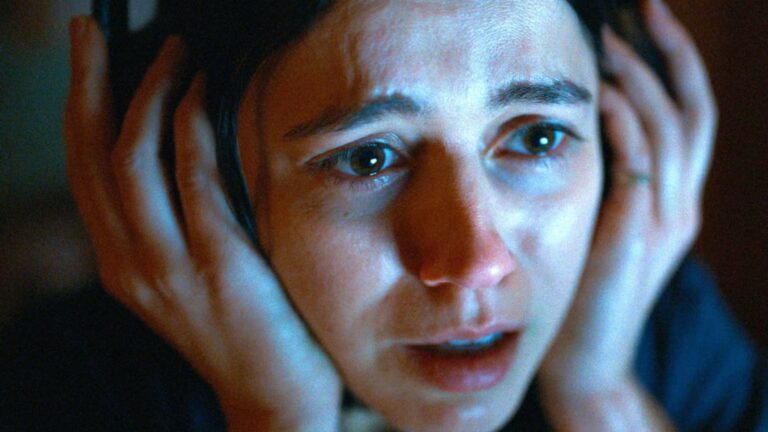
Twenty-something Evy (Nina Kiri) serves as caregiver to her unconscious, terminally ill mother (Michele Duquet) in Mom’s large, empty house. Between cleaning up after (and taking care of) her invalid parent, she podcasts about the paranormal from her childhood home with online cohost Justin (an in-voice-only Adam DiMarco) chiming in from the interwebs.
Justin receives an email with ten mysterious audio files, which appear to be documenting a couple descending into madness. And with the playing of each successive file, the podcasters themselves are further drawn into the very dark spell conjured by the audio. Soon, seriously wiggy shit begins going down. And the shadows and ambient noises that envelop Evy’s mother’s home begin to take on a sinister life of their own.
Many of Undertone’s aforementioned artistic choices likely stem from budgetary constraints. Only two human beings are seen on camera through the entire run time, and only one of them appears to be sentient and conscious throughout. Our view never ventures beyond the house’s four walls, and nearly 100% of the film zooms in on Evy alone, as melancholy, curiosity, and raw fear threaten to get the best of her.
Happily, for a good chunk of the film, you barely notice the low budget. Kiri delivers an utterly natural performance, and Evy comes off as a charismatic and empathetic central figure before the end credits roll. The house in which all of the movie’s action takes place emerges as a character in its own right, with the majority of its interior swathed in a darkness that Graham Beasley’s moody cinematography renders almost tactile.
Undertone’s biggest asset turns out to be the mix by sound designer David Gertsman and his team. The soundtrack’s symphony of ambient noises, whispers, disembodied voices, growls, wind gusts, and God knows what else ricochets back and forth across multiple channels, giving this ostensibly modest little chiller a sense of immersion worthy of a movie boasting 20 times the budget. That sound mix alone merits the price of admission, and it’ll flat-out knock your socks off in a theater equipped with a good sound system.
But for all of its audio-visual brilliance, and Kiri’s impressive work almost singlehandedly carrying the entire movie, Undertone’s shortfalls become straight-up frustrating.
The movie’s slow-burn pacing downshifts into sluggishness a bit too frequently. And while I’m generally a fan of horror films that don’t explain everything to death, gaps in continuity, motivation, and narrative cohesion ultimately pole-vault over dream logic and end up rousing more irritation than tension, catharsis, or unease.
The script hints that Evy’s relationship with her mom is fraught, but what’s onscreen offers next to no elaboration. As a result, Evy’s forced to become a bit of a blank slate thanks to the patchy script: We just don’t spend enough time getting to know her, or the dynamic that informed the apparent tension and conflicting emotions between her and her mother.
Tuason’s script lays out at least three disparate, potentially fertile (and potentially bone-chilling) story tangents as the movie goes on. Most of them lead to unsatisfying dead ends. Consequently, the final product feels more like a horror trope clearing house than a fully-realized vision—a potential classic compromised by a lot of cutting to hit its 93-minute running time.
There’s always ambiguity and a sense of incompleteness embedded in a loved one’s decline. And the finality of their death seldom offers the complete closure human beings long for at their collective core. I know. I’ve been there, and am living it right now. I’m genuinely happy that Tuason’s been able to channel his grief into a movie that’s connecting with a significant percentage of critics and viewers. But if anyone’s seeking the closure inherent in a cut of Undertone that takes it from frustratingly incomplete to masterfully realized, it’s me.
Undertone opens Friday March 13 in theaters everywhere. Image courtesy A24.