


Project Hail Mary (2026 | USA | 256 minutes | Phil Lord & Christopher Miller)
Phil Lord and Christopher Miller’s hotly anticipated adaptation of Andy Weir’s beloved sci-fi novel Project Hail Mary arrives in theaters this weekend. For those (like me) who haven’t read the book but don’t want too much spoiled, the plot is Interstellar meets Arrival as conceived by Looney Tunes. I mean this as a compliment. Set on a grand canvas of outer space with the fates of worlds hanging in the balance, it’s an awe-inspiring visual spectacle whose heart is a story of silly little guys doing their very best.
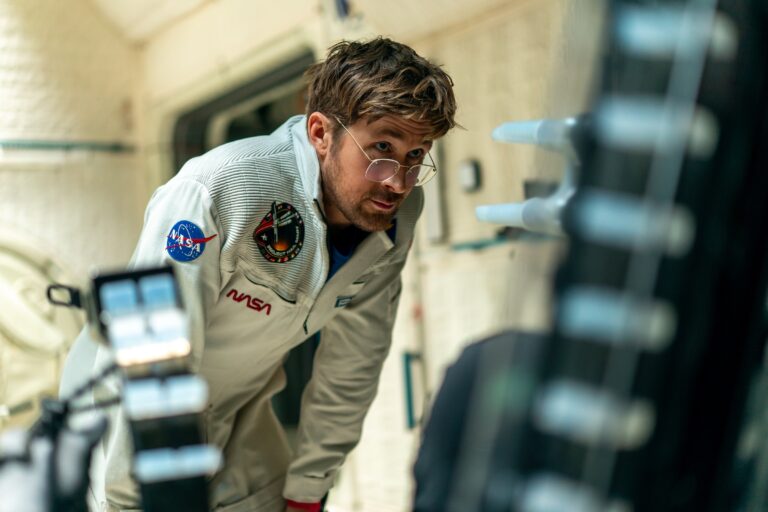
With recent triumphs in the dexterously inventive animation of the Spider-Verse, co-directors Lord and Miller get the flesh-and-blood equivalent of an animated character with Ryan Gosling, who’s responsible for holding the screen for more than two hours. He’s a perfect fit. Over his career, he’s played a troubled middle school teacher, a lonely astronaut, and a living doll confused about his place in the universe. Here, he finally gets the chance to play those three roles all at once with Ryland Grace, a scientist castaway on a mission to save the Earth, if he can only remember a few key details.
When we first meet Ryland Grace, it’s by way of a rude robotic awakening after a long induced coma. Hair overgrown and bearded, he emerges from a sleeping bag in a full-body latex astronaut undergarment, deeply confused and scrambling through a three-dimensional maze of a spacecraft. A madcap zero-G tour of the facility reveals that he’s the sole survivor of the mission with no idea how or why he’s found himself more than eleven light years from home.
Gosling’s embodies Grace almost as a living cartoon character: all soft around the handsome edges, floppy hair, glasses askew, a chunky vintage Wolf Cowichan custom Mary Maxim-inspired Fox-emblazoned knit cardigan that I’d kill for rather than pay the eBay prices. Sometimes he’s even in a big yellow raincoat like a Bay Area Paddington. He makes his way through the film’s altered gravity with the mechanics of someone hand-painted into it. It’s tremendously effective. I want that coat, I want the sweater, I even want his haircut. But most of all, I desperately want this doofus scientist to figure out how to save our godforsaken planet, which almost certainly does not deserve the sacrifice of his good-natured ingenuity.
As Grace in Space putters around his starship (The Hail Mary) in a mild brain fog, the Earthbound story of how he came to be out there is revealed in intermittent flashbacks (meant to convey the fits and starts recovery from the fog of deep coma-induced amnesia) Why he remembers stuff like “how to get around a spaceship and fly it around” but not “why am I out here in the first place” is mildly gimmicky but you’ve just got to roll with it. Similarly, our confusion about operational details has to be chalked up to his foggy memory, otherwise this story will drive you insane. Plundering the crew’s vodka and costume reserves, he starts to interrogate himself with a classic “who am I?” whiteboard session [record scratch … you’ll never guess how I got here meme].
Big scary science? “Explain it to me like I’m a middle schooler,” you might say. And if so, you’re in luck because that’s exactly what retired microbiologist-turned-classroom instructor Ryland Grace was up to before the scariest thing imaginable happened to him (being asked to revisit your doctoral dissertation by a bunch of scientists decades after you published it). The Sun has begun to dim, an amateur astronomer (Petrova) noticed an infrared line connecting it to Venus, and NASA has just come back from taking a sample. We get the sense that everyone on the planet is worried, but it’s a matter better left for kids to talk about with their parents. We get enough information to set the stage, establish dire stakes, and introduce a ticking clock that’ll mark the end of the planet as we know it within a few decades.
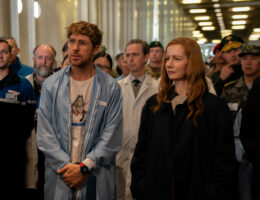
He’s whisked out of the classroom by a hilariously dry Sandra Hüller, perfect for the role of a no-nonsense double Venti coffee drinker leading an international consortium of governments who are suddenly very interested in this Bay Area teacher’s stale old research: the likelihood of extraterrestrial life that isn’t based on carbon and water. It was an idea (or rather a personality) that was too iconoclastic for academia, but one of sudden relevance to the fate of the world. We see him alone in an isolated laboratory making some discoveries about space bugs (sorry, “astrophages”), doing some Home Depot-style improvisations to further his breakthroughs, and eventually getting whisked into becoming a high-level advisor to the long-shot project to send three people on a one-way mission to the one star in the galaxy not being drained by these hungry critters. That humans are out there at all and not a fleet of AI robots is not explained, but feels quaintly optimistic. The explanation of why this particular human is on the mission will have to wait until until deep into the movie to be revealed.
The backstory of science and consortia and progress on earth is clever, but the real show is out there in the stars. Soon after waking, the ship’s only occasionally helpful computer system recognizes another blip out there with them. So begins a series of interactions between the earthly vessel and a gorgeous glittering wireframe spacecraft that’s also visiting the neighborhood. The ships play little cat-and-mouse space chases, get to know each other via cryptic messages tossed across the divide in the alien equivalent of bank tubes, all eventually leading to a close encounter of the best kind, in an umbilical corridor linking two lonely spacefarers.
I marveled earlier about the conception of Gosling’s warm, fuzzy scientist; all the better to contrast with the fellow traveler he meets across it’s when he meets his fellow traveler through a glass partition. A giant five-legged hermit crab seemingly made entirely of rock, and without anything resembling a face, this creature is similarly alone and on a planet-saving expedition. Grace dubs him Rocky, and as they get to know each other through arts & crafts projects, interpretive dance, and computer-assisted translation, Lord and Miller make us fall in love with this craggy creature almost instantly through the power of practical effects, puppetry, and endearing voices. The most deeply I’ve connected to a pet rock since the silent googly-eyed canyon vignette in Everything Everywhere All At Once? Most definitely.
The filmmakers have boasted about the real sets, in-camera effects, and the absence of blue (or green) screens. The result of this physicality is felt throughout, but no more so than in the wondrous creation of Rocky. Theater artist James Ortiz both voices Rocky and served as lead puppeteer (sorry, Lead Rockyteer). Although Gosling ably holds the screen for long stretches as the only human in frame, the presence of an actual “creature” (designed by Neal Scanlan, who won an Oscar for Babe before taking to space with Star Wars), performed by an actual human, on the same set makes this faceless alien a credible co-lead who speaks in charmingly simple computer translations of its own complex language. I would die for this space crab (or at least, to get a plush version to sit on my shoulder).
Working together in fits and starts, the interstellar bromance between Grace and Rocky grows first across the divide and later, via a polyhedral hamster ball, as adorably awkward roommates with access to science labs and a 4DX home theater setup. Eventually, they hatch another long-shot plan that puts them in extreme peril in order to make a major breakthrough. As conceived by production designer Charles Wood, the film’s sets reflect a kind of purpose-built practicality with whimsical inspirations like loosely anthropomorphic robots, and a series of connected corridors whose geometry changes based on the ship’s balletic implementation of artificial gravity. The physicality of the sets makes the big-screen filmmaking all the more breathtaking. Cinematographer Greig Fraser and VFX supervisor Paul Lambert (most recently of the Dunes) leave behind the harsh palette of Arrakis, culminating in a dazzling series of sequences involving swirling spectral clouds of an alien planet: first in a swooning spacewalk scene and later in a pulse-pounding action sequence. Throughout, be it introspection, innovation, or peril, Daniel Pemberton’s evocative choral score compliments stunning visual effects to steer the action and ground the sentimental values.
With a runtime approaching three-hours, I can imagine that people who have never done science might find the stop-and-start discoveries, repetitive, or dull. Those who have had any exposure to scientific work, on the other hand, might be irked with just how quickly and seemingly easily complex breakthroughs abound, let alone the lack of detailed explanations committed to the screen. For my money, screenwriter Drew Goddard — having previously adapted Drew Weir’s work with The Martian — again strikes the Goldilocks zone. Again and again, the movie teaches us how to watch, shows us how these characters, as they encounter problems, overcome setbacks, and solve problems. That much of the tedium is elided through montage, and the frustrating passage of time is conveyed through stubble, never dissipating the thrill of each eureka moment.
The film’s highs are very high, be it the special effects of space or the incandescently humane magic of a highly caffeinated Sandra Hüller taking a reluctant turn from her usual solitude to join a karaoke farewell party with precisely the perfect song for the moment. (A little callback to Toni Erdmann?) She’s so terrific in this role, bringing dry comic relief alongside sincere, clear-eyed dedication to saving a world hurtling toward its worst impulses. It’s a movie about introverts making deep connections with few words. Grace and Rocky spend months working together, exchanging the scantest bits of personal information, and become best friends. To me, at least, for better or for worse, this is incredibly relatable. And yes, that space crab made me cry. (Amaze. Amaze. Amaze. As the cool crabs say.)
With that said, it is a testament to how deftly Lord and Miller play the emotional strings of this unlikely interstellar bromance that I was able to so completely allow the warm fuzzies to drown out my left brain’s nagging screams about individual plot points and operational decisions. I really don’t blame anyone who can’t set these impulses aside so easily, but I also feel a bit sorry for them. The filmmakers are throwing this big, incredible story our way; we just have to be in the right spot to catch it.
Project Hail Mary arrives in theaters on March 19th, see it on the biggest screen you can. (With Seattle’s only true IMAX theater closed in the wake of a real estate transaction, this probably means SIFF Downtown)
Image courtesy Amazon MGM Studios.