

My Wife Cries
(2026 | Germany/France | 93 minutes | Angela Schanelec)
My Wife Cries is as wonderful a film Angela Schanelec has ever made about the unknowability of others and the inexhaustible beauty of the everyday. Thomas (Vlademir Vulević), a construction worker, receives a call from his wife, Clara (Agathe Bonitzer), and finds her crying on a park bench. Though she initially seems distraught over her involvement in a car accident, we discover that this offscreen event, which re-emerges later in the film, is simply a punctuation mark to an affair that started when Thomas stopped attending dance lessons with her.
Both the title and this opening stretch make it seem like this is Schanelec’s first film to really center a man (Music, a very loose Oedipus adaptation, notwithstanding), but most of My Wife Cries actually follows Clara as she wanders throughout Berlin in ways that feel like a maturation of Schanelec’s early trilogy of Places in Cities (evoked in the car crash story), Passing Summer, and Marseille. There’s a lot of I Was At Home, But… in here as well (she even sorta repeats the iconic Pieta-like image near the end), what with the tracking shots and the Straub-ian style of recitation that’s become Schanelec’s stock and trade.
That subjective disconnect between the film’s title and content is the essence of Schanelec, who operates at extremes of naturalism and theatricality, searching for some sort of reconciliation, whether it be through words, performance, movement, or radiant, shimmering light. The sense of unreality is as much an effect of her dialogue, with its lengthy, monotone discussion of offscreen events, real or imagined, as her montage, which seems to constantly undermine our understanding of spatial relations, even in the simplest of conversations. In their attempt to access characters’ ineffable private lives, Schanelec’s films aim for the transcendent in the most basic sense of the word. Her attitude towards surface is succinctly explained during a character’s birthday celebration. After receiving smiling childhood photos from his mom, he turns to his girlfriend and tells her, “I was just born, but I was already so anxious”.
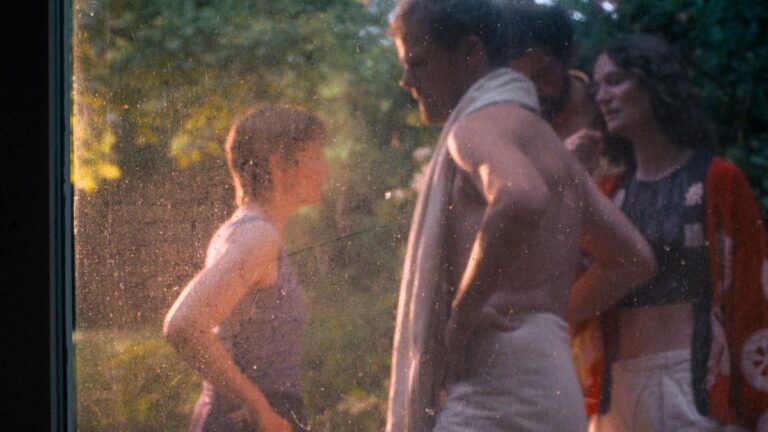
The mystery that emerges through Schanelec’s montage and performances is only matched by the ecstatic beauty of what’s in the frame. Portraits of bodies, whether they be of a delicate sleeping face or a naked body are bathed in soft, golden light. In the park, the light and wind streaming through the trees have the sensual touch of an experimental filmmaker.
This would ordinarily make Schanelec someone who seems suited for digital filmmaking, but I appreciate that she’s someone who’s committed to mining the expressive depths of the Bressonian model, whose needle drops have never wavered from the 70s American pop of her youth. The rare moments of musical synchronicity are instantaneous and sort of ridiculous. In one example, a conversation between Clara and her coworker in the park is interrupted by an impromptu band performance, one that’s dismantled by the rain as soon as it starts. Later, while Clara is ill and resting on the couch, Thomas and her friends spring into a fully choreographed dance to Leonard Cohen’s “Lover Lover Lover”, the sort of laughably cartoonish number that’s nonetheless a moment of collective feeling, and one that Clara realizes she’s on the outside of when she wakes up. She gets her own near-miraculous encounter in the final image, a reverse-shot held just long enough to register its narrative import that seems to quiver with emotional import.
My Wife Cries played at NYFF on September 28, 29, and 30. It is currently seeking distribution.
Image courtesy NYFF.