



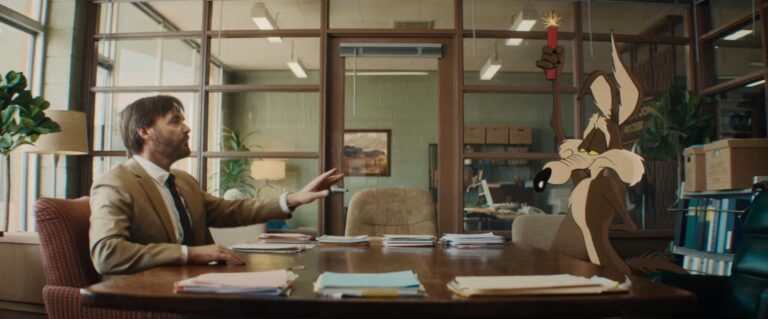
Coyote vs. Acme
(2026 | USA | 103 minutes | Dave Green)
Back in 1988, Robert Touchstone Pictures had the bravery to allow Robert Zemeckis to show cartoon characters interacting with real human actors, demonstrating that our two-dimensional friends could have three-dimensional wants and needs, be they bombshell ingenues or horned-up rabbits framed for crimes they didn’t commit in the nineteen forties. Who Framed Roger Rabbit went on to become one of the highest-grossing films of that year, took home multiple Oscars, and sparked Disney’s animation renaissance. The mid-1990s brought Space Jam, further expanding ‘Toon representation on screen to show that cartoon characters could hold their own on the basketball court alongside real-life NBA stars like Michael Jordan, Patrick Ewing, and Charles Barkley. It made a ton of money, lives on via sequels and retro t-shirts, and heralded a new era of sports figures as media personalities.
Now, a quarter of a century into the 2000s, Coyote vs. Acme is the film that finally dares to question a new dimension of how cartoon characters are Just Like Us: namely, crushed by years of indifferent abuse by mega-corporations in the name of profit. That the film nearly didn’t make it to the screen because a mega-corporation stubbornly concluded that they’d be better off taking a tax write-off rather than releasing a completed film that they’d spent more than 70 million dollars and a decade developing, is a fascinating meta-narrative that makes it especially emblematic of these very strange times that we find ourselves living. What makes the story of Warner Bros.’ multi-year saga of turning a film into a write-down before eventually selling it to Ketchup Entertainment for theatrical release all the more bizarre is that the film is actually all the way good.
Based on a satirical essay by Ian Frazier in the New Yorker with a screenplay by Samy Burch (May December), the film opens in an ominous factory where a troubled scientist with a strong resemblance to Peter Lorre attempts an act of whistleblowing before being chased and imprisoned in a classic cartoon hole. Back in the modern-day desert outside of beautiful Albuquerque, New Mexico, we find Wile E. Coyote well into his seventh decade of fruitless pursuit of the Road Runner. Gaunt and visibly starved, the canine is once again failed by a series of faulty products, like rocket-powered roller blades in his pursuit of a much-needed meal. Licking his wounds and contemplating the uncountable number of times that an Acme Corporation catalog over-promised and under-delivered, the Coyote gets his next big idea from an ad on basic cable from a strip-mall lawyer (Will Forte as Kevin Avery). His firm, Avery, Jones & Maltese, promises satisfaction for ‘Toons who have suffered grievous indignities.
Forte’s an appealing parallel to the ever-suffering Coyote as a down-on-his-luck lawyer who’s also scraping by on crumbs. He encourages the aggrieved beast to take a quick cash settlement, but — with a little unwitting assistance from Paige, Kevin’s still-idealistic new lawyer and niece (Lana Condor) — Wile E. has his sights set on getting his day in court. Performed on set with a puppet and animated as a silent character on screen, the coyote communicates entirely via expressive facial contortions, body postures, and a limitedseries of signs. Sight gags and schemes, animated and otherwise, set them up to face Acme Corp’s menacing lawyer, Buddy Crane (a suitably cartoonish John Cena), in a massive class action lawsuit that immediately captures public opinion. Railroaded into a speedy trial, Paige and Kevin dig into the deep, dark secrets of the mega-corp via a series of document discovery, gumshoe investigations, and clandestine meetings with a series of classic Looney Tunes stars.
Holed up in a fleabag motel, Kevin haplessly tries to unravel a vast conspiracy while barely noticing a smaller one going on right in front of him. With a delightful original score from Steven Price (an Oscar winner for Gravity) and inventive visual language throughout, each caper and episode moves along at a sprightly pace. With much of the pleasure coming from the audience being a step or three ahead of the characters, their rocky road to satisfaction will lead them to a huge congressional showdown that raises questions about eligibility for Senate races and the bar exam in this reality. Like her work in May December, Samy Burch’s script does wonders for making the vehicles of satire still feel like three-dimensional characters. While it’s unsurprising that Will Forte is able to pull off an impassioned speech about the power of friendship to a cartoon character, the film’s most moving moment might just be a famous pair of single syllables.
Enjoyable from start to finish and fun for the whole family, one can hope that the untoward saga of Coyote vs. Acme‘s bizarre path to wide release will fade in light of the quality of the film itself. Still, it’s deeply odd for this film to be released just as we find ourselves watching helplessly from the sidelines as what appears to be a disastrous studio merger involving WB’s absorption by Paramount on the wings of some shady characters of its own winds its way through the legal system. Having finally seen it, I can understand how a movie about a megacorporation churning out dangerous slop to a vulnerable population would be deemed too dangerous to release once the execs realized the bloviating CEO, not the ineptly insatiable deadbeat carnivore, was the villain.
Coyote vs. Acme arrives in theaters on August 28
Lead image courtesy Ketchup Entertainment