



Hanabi
(2026 | France/Brazil | 107 min | Ana Vaz)
Ana Vaz’s beautiful new feature, Hanabi, is described as a “savage” adaptation of Yoko Hayasuke’s “Journal of a Radioactive Brain”. Written after the 2011 Fukushima nuclear meltdown just over a decade ago, Hayasuke’s autobiographical text recounts the paranoid neuroses that emerged in the fallout of the event, especially after everything “returned to normal”, when everyday reality suddenly became fraught with the invisible perils of radiation.
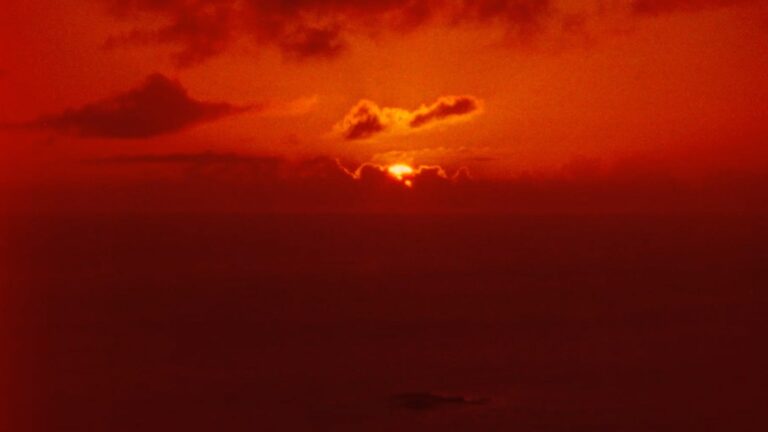
Vaz’s take on the material looks like a post-Sans Soleil diary film without a coherent subject. The film springs from the collaboration involved in its creation, turning it into a work of collective subjectivity. We see the correspondence between Yoko and Vaz as they discuss the direction of the project, and the interweaving of their images as Vaz’s diaristic travelogue is sequenced with Yoko’s mini-DV accounts. It’s a difficult film to pin down, best enjoyed in musical terms as it plays on the modes of city symphony, landscape film, and ethnographic portraiture, capturing the eeriness of the quotidian and the possibilities for rehabilitation. The sheer range of formal choices displays a playfulness that I rather enjoyed. At various points, Vaz is swinging the camera in circles at the beach, sustaining a static minutes-long shot of a blood-orange sunset, and in a stunning final movement, shooting fireworks in reverse, an image that’s especially resonant following the recent passing of Tomonari Nishikawa.
All of these images are paired with de-synced sound, drifting between testimonials from citizens Vaz has encountered throughout her travels in Japan, and her own voice-over, mixing translations of Yoko’s text with her own reflections. When dates flash on the screen, it’s entirely unclear if they’re describing when the footage was shot, when the diary entry was created, or when an interview was conducted, leaving the film as an emanation from the collective subconscious.
The approach is clarified by two strands. First, we hear an interviewee remark that during a tsunami, residents are instructed to simply run without consideration of family or friends, marking the disaster as one that precipitates a breakdown in community, turning Hanabi’s form into an attempt towards psychological reconstruction. Second, Vaz’s pregnancy becomes a brief subject, and the film reckons with the world her child will inherit. We often talk about younger generations being left to deal with the problems of an older one, but Hanabi’s inter-generational dialogue is about the work we can do now to counteract the symptoms of modernity.
Hanabi plays at NYFF on October 8th and 9th. It’s currently seeking distribution.