



You Can See Everything (2026 | USA | 174 minutes | Nathan Fielder, Lance Oppenheim)
You Can See Everything documents the days leading up to Theranos founder Elizabeth Holmes’s 11 years, three months of incarceration at a minimum security prison in Texas that began on May 30, 2003. Despite enduring a criminal trial that ended in convictions for defrauding investors, Holmes appears dumbfounded that she would be subjected to imprisonment and doesn’t appear to have an answer as to why she’s in the position she’s in. Please allow me to try.
Elizabeth Holmes founded Theranos in 2003 at age 19, after dropping out of Stanford, promising to revolutionize health care by creating a technology that could run as many as 200 tests on a few drops of blood from a single pin-prick. She raised over $700 million from investors like Rupert Murdoch, Carlos Slim, the Walton family, and Larry Ellison. At its peak, the company would be valued at $9 billion and Holmes owned approximately half of the company. The technology never worked as promised and Holmes and her former boyfriend/COO Ramesh “Sunny” Balwani engaged in a years-long campaign of deceit to hide the failing technology from investors and regulators. Employees who challenged Holmes or Balwani, questioned the technology, or raised concerns about patient safety frequently faced intimidation, retaliation, or dismissal. The company concealed technical failures and delivered inaccurate laboratory results to patients, some of whom received results suggesting very serious medical conditions, including cancer. Meanwhile, Holmes was a genuine rock star, a Silicon Valley wunderkind who racked up accolades and billions in paper wealth based on technology she had repeatedly been warned was unworkable as promised. She continued to tout its promise even as patients made health decisions based on unreliable results. Holmes was convicted of defrauding investors and Balwani was convicted of defrauding investors and patients.
This has all been documented in publicly court documents, as well as through the reporting of John Carreyrou in the Wall Street Journal and his essential 2018 book Bad Blood: Secrets and Lies in a Silicon Valley Startup.
Feigns of ignorance or not, Elizabeth Holmes has earned every moment of her prison sentence. Now that we have that out of the way, let’s talk about the movie.
For some inexplicable reason, TV star Nathan Fielder (along with veteran documentarian Lance Oppenheim) was given almost unlimited access to Elizabeth Holmes and her boyfriend Billy Evans, an heir to the Evans Hotels hospitality group and tech entrepreneur, in their San Diego rental home. He is an omnipresent figure in the Evans-Holmes household and it’s a bit unsettling when we see him looking on during unguarded moments. But he and his cameras are there all the time, including when Evans takes a shower. The result is one jaw-dropping moment after another.
While Fielder might be a curious choice, he was also an inspired one. His show Nathan For You rests on the premise of saving small businesses with schemes like liquor stores selling minors a voucher for booze they can pick up once they turn 21 or a gas station offering a rebate that you have to climb a mountain to collect. The schtick works because people are usually too polite to say “this is ridiculous.”
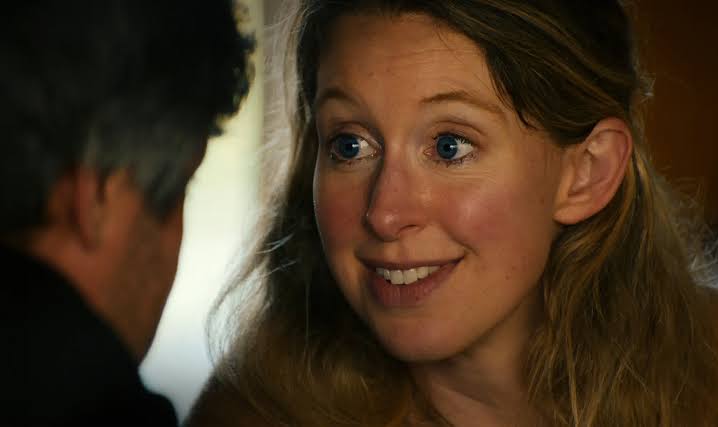
Holmes, who looks like a Disney character with enormous eyes (it’s been meme-ed to absurdity already), does not appear to have much, if any, self-awareness. She is fully committed to her ignorance and innocence, even when it beggars belief. She tells Fielder at one point that she has no idea what she was convicted of, and at another that she has never told a lie, not even a white one. At one point, Fielder makes Holmes and Evans watch Abbott and Costello’s “Who’s on First?” routine to illustrate what it’s like to interview her.
Although I’ve likely followed the Theranos as close as any other film critic in America, this movie continued to shock me moment after moment, with nothing you can do to prepare yourself for it.
While the scenes with Holmes wild themselves, the movie reaches its maximum velocity without Holmes, while Evans acts as her voice while she’s in prison. I run the risk of spoiling too much because it’s a documentary that reveals one unexplainable and inexplicable moment after another. I still cannot comprehend a scene where Evans gets particularly heated defending Charlie Kirk.
Throughout You Can See Everything, I found myself frustrated that viewers might not grasp how terrible Theranos’s misdeeds are, as it’s never really spelled out and Fielder never confronts Holmes about most of what I mentioned in paragraph two. I thought the same thing with Lance Oppenheim’s previous film Primetime, which I thought failed to capture the true rot of NBC’s To Catch a Predator, while still being damning and riveting.
Like Exit Through the Gift Shop, You Can See Everything works as a puzzle that you try to solve in real time while knowing that you can’t trust what you’re seeing. The narrators are too unreliable. But you probably won’t believe whatever Elizabeth Holmes and Billy Evans tell you. You shouldn’t.
____________________________
You Can See Everything opens in theaters everywhere today, October 16.