


Teenage Sex & Death at Camp Miasma (2026 | USA | 112 minutes | Jane Schoenbrun)
In Jane Schoenbrun’s latest film, an auteur and aging starlet are intertwined in a fantastical journey of self-discovery inspired by an imaginary 1980s slasher franchise about a psycho killer with a metal HVAC block for a head, a twin-tipped sea spear for a weapon, and the provocative nom de sangre The Little Death.
With obvious affection for the likes of Friday the 13th and Sleepaway Camp, the best storytelling might just be in its opening credits that situates the audience into the fictional reality. An ingeniously handcrafted montage communicates the decades-spanning cultural phenomenon surrounding a horror film franchise. Through headlines and lovingly handcrafted ephemera, we see how the film became a phenomenon that inspired sequels, board and video games, and action figures. A string of press clips hint at reclusive stars, actors dropping out of sequels, and the franchise taking a nosedive into obsolescence, the Trans killer being reappraised as problematic, later re-evaluated and reclaimed by the culture, to the point that a reboot helmed by a Sundance wunderkind is in the works. Set to an Okay Kaya cover of R.E.M.’s “Nightswimming”, it’s both a cheeky reference to Camp Miasma’s killer periodically emerging from a lake to exact revenge, the potency of clandestine sexual awakenings, and proof that no 1990s original was too slow and moody to escape the “make it even slower and more moodier” cover trend.
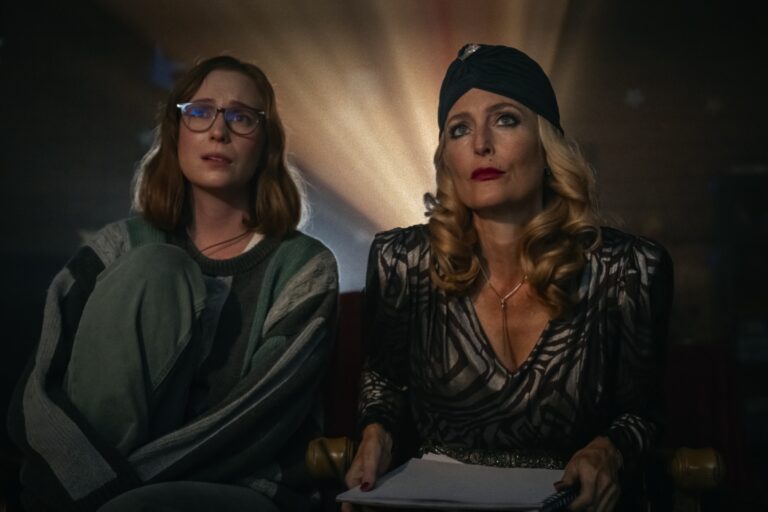
With the montage having set the milieu, the film introduces this “wunderkind” in the form of Kris (a bespectacled Hannah Einbinder), an auteur whose critically-praised festival debut may not have won a mass audiences, but who caught the attention of studio execs eager to to potentially valuable “zombie IP”. All the better if it’s retrospectively-problematic representation issues can be cleansed at the hands of a young queer woman in an unsatisfying polycule. Kris heads to the rural unspecified Pacific Northwest to seek the approval and participation of Billy, the reclusive “final girl” from the original Camp Miasma. Although she’s only planning a two night trip, Kris stocks up with shopping carts full of candy at the local gas station where she even finds a copy of one of the franchise’s many sequels to watch on the hotel’s dusty DVD player accompanied by a giant tub of popcorn and added Raisinets. [As a dedicated popcorn and peanut M&M’s guy (possibly also a Mr. Robot reference?), I was immediately a mix of appreciative and skeptical.]
Soon enough, a shaky GPS leads Kris to Billy’s residence: surprisingly only to her, it’s the filming location of the original Camp Miasma. Surprising to audiences is that Billy is portrayed by Gillian Anderson, styled like a Golden Age Hollywood pinup with a Blanche Dubois (extremely fake-sounding) Southern accent. How or why a one-and-done teen starlet from a pulpy franchise could afford to purchase a defunct summer camp and preserve it as a something between a museum and a Sunset Boulevard callback is not addressed. Instead, the fantastical matte painted backdrops signal that Kris’s every step along the long snow-covered driveway and through the uncannily preserved grounds is one further from one reality and into another experiential realm where such practicalities are orthogonal to the point (and especially irrelevant to Schoenbrun’s interests).
Somewhat reluctantly and awkwardly, Kris is entering into a pas de deux with an alluring but oddball shut-in. It’s one that will involve revelation, self-discovery, seduction, and a comedically exceptional quantity of fried chicken (and even more dipping sauces). From oversized dinner tables, to storybook fireside chats and chalet-style conversations overlooking an enchanted-looking forest, the women reveal intimate details of their own sexual histories, hangups, frustrations, and desires. Einbinder is good in familiar territory as a bottled-up creative, but Anderson’s commitment to the role and all its many hammy eccentricities is deeply admirable and the only miraculous reason that any of this works.
When we finally see the original Camp Misama, it’s as a movie-within-the-movie projected with film nerd eroticism from an original 35mm film in a private screening room on the grounds of the old campground. As we watch Kris and Billy watch (and watch each other watching), it’s clear why this flick made such an impression. The way that Schoenbrun films each of the actresses as they experience the film makes it clear that it still holds an intense power over them both. Much like the depiction of The Pink Opaque in I Saw the TV Glow, these scenes of camp counselors meeting ahead of the season, testing each others limits, and eventually getting gruesomely murdered looks nothing at all like 1980s teen slasher dreck. Instead, its shot with a mix of outstanding production values and so many outlandish fountains of Kool-Aid red blood, convey how its protagonist remembers seeing it as a too-young, too-impressionable kid who got their hands on a VHS tape one fateful night. The climactic bloodshed is scored with an entirely improbable 1990s hit radio ballad, although this time nothing but the original will do.
The centerpiece one-shot horror sequence unlocks deeper levels of understanding, changing Kris’s approach to the reboot, and pushes all the action further from conventional reality into fantastical imaginings and a potent, blood-soaked, crescendo of self-discovery. Early on, Kris describes her work as having considered Psycho from the perspective of the shower curtain. I assumed this was a little bit of a self-own on Schoenbrun’s part, an in-joke at their own self-serious expense via a bottled-up stand-in. But as the film presses toward a figurative and literal climax, one appreciates the deadly and erotic seriousness of the proposition. While still entrenched in the paradoxical ways that imaginary settings can feel more “real” than reality, Schoenbrun’s first film made post-transition finds their interests centered more deeply in the possibilities of long-delayed bodily pleasure, be it sex or mountains upon mountains of sugary sweets.
As a visual work of self-expression, Teenage Sex and Death at Camp Miasma is undeniably striking. However, the split in its mode of storytelling and corresponding intentions will be frustrating for anyone – myself sheepishly included – who was expecting a campy re-imagining of slasher horror tropes. The vibes might be impeccably intoxicating, but anyone so pedestrian as to care about plot might find themselves disappointed as the action presses further from convention. Appreciating Schoenbrun’s exceptional skills as a visual stylist and phenomenal facility with recontextualizing cultural artifacts, one wonders if it’s selfish (or terminally square) to imagine their next film and ask “why not both?”
Until then, we’re fortunate to have a front row seat to a major emerging artist who’s deploying a substantial budget to evocatively work-through their self-revelations on big, bold, beautiful canvas. As one of the slasher sequel’s advertising copy, helpfully posted boldly around the abandoned camp, promises: “If it gets too real you can always turn it off.”
Teenage Sex & Death at Camp Miasma arrives in theaters on August 14, including a 35mm film presentation at SIFF Uptown.
Lead image courtesy of MUBI